




The Great Martian Mystery
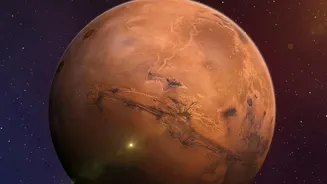
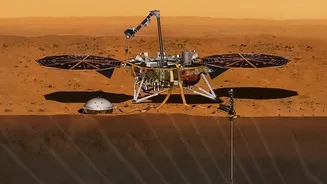
For decades, scientists have been captivated by a single, profound question: Where did all of Mars’s water go? We see the evidence of its past everywhere. Robotic explorers have sent back stunning images of dried-up river deltas, vast lakebeds, and deep
channels carved by ancient floods. These features prove that billions of years ago, Mars was a far warmer and wetter world. Yet today, its water is almost entirely locked away as ice at the poles. Understanding this dramatic climate shift from a potentially habitable world to a barren one is one of the biggest puzzles in planetary science. The answer, it turns out, was hiding in plain sight, trapped within the planet's very geology.
A Glimmer of Opal
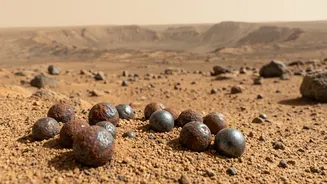
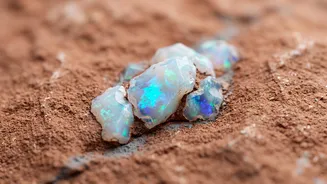
The breakthrough came from an unlikely source: gems. Rovers like Curiosity and Perseverance, while exploring craters, began noticing light-coloured halos of rock lining fractures in the ground. Upon closer inspection with advanced instruments, scientists confirmed these halos were rich in hydrated silica, a mineraloid more commonly known as opal. On Earth, opal is a beautiful gemstone, but on Mars, its significance is far greater. Opal is an amorphous form of silica that forms when silica and water mix. Its structure physically traps water molecules. You cannot make opal without water, making its discovery an irrefutable signpost of past liquid water.
A Story Locked in Stone
These hydrated minerals do more than just confirm water was present; they act as a detailed planetary history book. Different minerals tell different stories. For example, clay-like minerals called phyllosilicates, found in older Martian terrain, suggest long-term interaction with neutral water over 3.5 billion years ago. Later, hydrated sulfates formed, hinting at a period when the planet’s water became more acidic and evaporated. The discovery of opal is particularly exciting because it's a much younger mineral. Its presence suggests that liquid water existed on Mars as recently as two billion years ago, a full billion years later than previous evidence indicated. This dramatically extends the timeline that Mars might have been able to support life.
More Than Just Water
The story gets even better. The way these crystals formed suggests the existence of diverse and potentially life-sustaining environments. Some opal deposits appear to be linked to ancient hydrothermal systems — essentially, Martian hot springs. On Earth, such environments are teeming with microbial life, making them a prime target in the search for extraterrestrial biology. Furthermore, these discoveries weren't just on the surface. Rovers found opal-rich halos lining vast networks of underground fractures. These subsurface cracks would have been filled with water and, crucially, shielded from the harsh radiation that bombards the Martian surface. This means that long after Mars’s atmosphere thinned and its surface lakes dried up, habitable, water-rich environments may have persisted underground.
A Future Water Source?
Beyond rewriting the past, these tiny crystals offer a tantalizing resource for the future. The water in opaline silica isn't just a chemical memory; it's still physically there, bound within the mineral. Scientists have calculated that these deposits could be a significant source of water for future human explorers. By simply mining the rock, crushing it, and heating it, astronauts could release the trapped water. According to one estimate, a single metre-long section of an opal-rich fracture halo could contain as much as 1.5 gallons of water in the top foot alone. In a world as dry as Mars, finding a widespread, accessible source of water would be a complete game-changer for sustaining a human presence.