




The Ghost Particle Mystery
First, let's talk about the ghost. The neutrino is a fundamental particle, like an electron, but it’s famously elusive. Neutrinos have almost no mass, no electric charge, and they barely interact with anything. They stream from the sun, from nuclear reactors,
and from some of the most violent events in the cosmos, passing through planets, stars, and even our own bodies without leaving a trace. This antisocial behaviour makes them incredibly difficult to detect. But it also means that when they travel across the universe, their path is a perfect straight line, unbent by magnetic fields. For decades, scientists have dreamed of using them as messengers, pointing directly back to the cosmic engines that created them. The biggest challenge has been figuring out where, exactly, to look.
Nature's Magnifying Glass
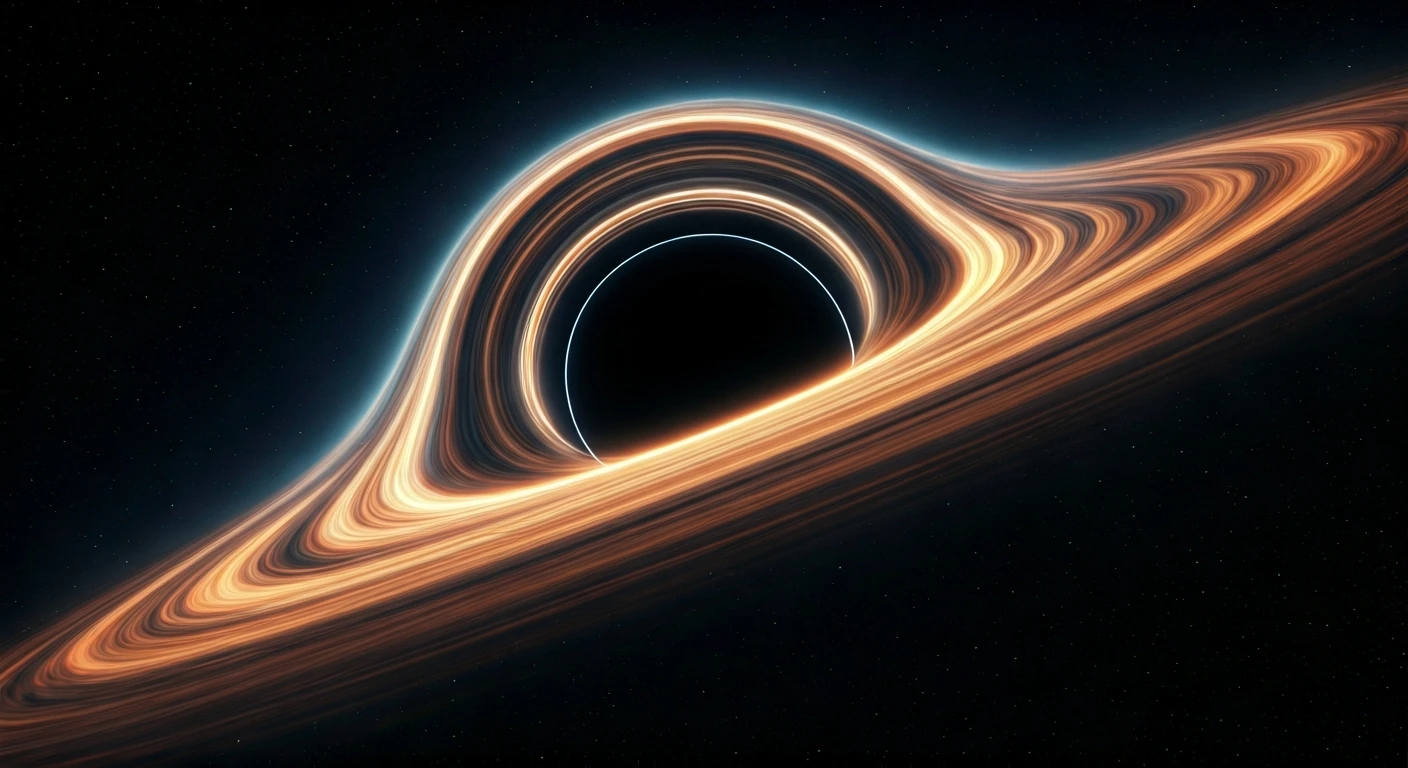
Now, for the lens. A 'cosmic lens' isn't made of glass; it’s made of gravity. According to Einstein's theory of general relativity, massive objects like galaxies warp the fabric of spacetime around them. Light—and neutrinos—traveling from a distant object behind the galaxy will have its path bent by this gravity. This effect, known as gravitational lensing, can magnify and even create multiple images of the distant source. Think of it as a natural telescope, billions of light-years wide, that can make faint, faraway objects appear brighter and easier to study. It’s a trick of nature that astronomers use to peer into the early universe. And now, it’s helping them hunt for neutrinos.
A Breakthrough Detection
The recent breakthrough came from a global effort focused on a single, high-energy neutrino that arrived at the IceCube Neutrino Observatory, a massive detector buried a kilometre deep in the Antarctic ice. The detector picked up the faint flash of light produced when the neutrino finally interacted with an atom in the ice. An alert was sent out, and telescopes around the world scrambled to find the source. At first, they found nothing. But by looking in a different kind of light—submillimeter wavelengths—astronomers found a dusty, incredibly active galaxy, nicknamed 'Shadow Blaster', in the right patch of sky. Crucially, they realised this galaxy's light was being gravitationally lensed by another galaxy in front of it. This lensing effect magnified the source, explaining why it was possible to connect it to the faint neutrino signal. Without the lens, the source would have been too dim to link conclusively.
Why This Changes Everything
This discovery is significant for a few key reasons. For a long time, scientists suspected that the most powerful high-energy neutrinos came from blazars—galaxies with supermassive black holes shooting out jets of particles. But this new source, Shadow Blaster, is different. It’s a 'starburst' galaxy, a cosmic factory furiously creating new stars. These findings suggest that such galaxies, common in the early universe, could be a major source of the background neutrinos we detect. It opens up a new class of potential neutrino factories. More importantly, it successfully demonstrates a new technique: using gravitational lensing to find and confirm neutrino sources. This combination of 'neutrino astronomy' and 'lensing' gives scientists a powerful new tool to probe the most extreme and hidden corners of the universe.