





Not a Rainbow, and Nothing to Do With Fire
First, let's clear up the name. A 'fire rainbow' has no connection to fire and isn't a rainbow in the traditional sense. The dramatic name likely comes from its vibrant, flame-like colours and wispy appearance. The scientifically accurate term for this
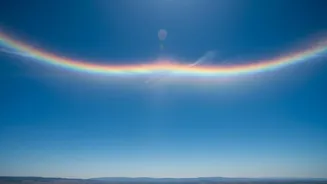
optical marvel is a circumhorizontal arc. Unlike a true rainbow, which is formed by the refraction and reflection of light in water droplets after rainfall, a circumhorizontal arc is created by light passing through ice crystals in high-altitude clouds. Rainbows form an arc opposite the sun, while a circumhorizontal arc is a colourful band that runs parallel to the horizon, far below the sun.
The Perfect Atmospheric Recipe
Seeing a circumhorizontal arc is a matter of being in the right place at the right time, under very specific atmospheric conditions. First, you need high, wispy cirrus clouds. These clouds, forming at altitudes above 20,000 feet, are composed of millions of tiny, plate-shaped hexagonal ice crystals. For the arc to appear, these flat, six-sided crystals must be oriented horizontally, like countless tiny prisms floating in the sky. The second crucial ingredient is the position of the sun. The sun must be very high in the sky, at an elevation of at least 58 degrees above the horizon. This high sun angle allows light to enter the vertical side of an ice crystal and exit through its bottom face, splitting the light into its constituent colours.
Why This Sighting Is Geographically Limited
The strict requirement of a high sun angle means that circumhorizontal arcs are impossible to see from certain parts of the world. In locations north of 55 degrees latitude (think parts of the UK, Scandinavia, and Canada) or south of 55 degrees latitude, the sun never gets high enough in the sky for the phenomenon to occur. The phenomenon is most commonly spotted in the mid-latitudes during the summer months when the sun reaches its highest point in the sky. When the sun hits an elevation of around 68 degrees, the arc reaches its peak intensity and brightness. This geographic and seasonal rarity is part of what makes each sighting so special.
What NASA's August 2 Image Adds
The image highlighted by NASA's Astronomy Picture of the Day (APOD) on August 2, 2026, was actually captured in 2021 over West Virginia, but its selection serves an important purpose. It provides an exceptionally clear example of a circumhorizontal arc in a cirrus fibratus cloud, allowing scientists and the public to see a textbook case of the phenomenon. By featuring such a striking photograph, NASA offers context and a visual anchor for explaining the precise physics involved. The agency uses these opportunities to educate the public on atmospheric optics, distinguishing these arcs from other phenomena like cloud iridescence or sundogs. Furthermore, NASA's broader research into cirrus clouds, using tools like LiDAR and spectroradiometers, helps scientists understand the properties of the very ice crystals that create these beautiful displays, contributing to climate and weather models.