







The Thirst Behind the Tech
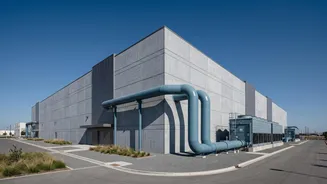
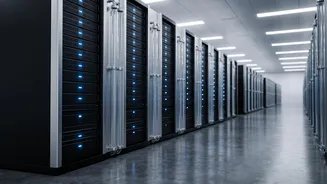
Every time you ask a generative AI a question, it sparks a complex computational process. This process occurs inside vast data centres packed with powerful servers. These servers generate an immense amount of heat. To prevent them from overheating and
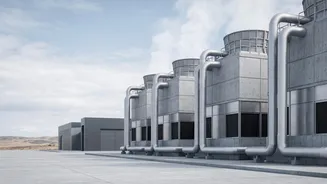
shutting down, they must be constantly cooled. While some cooling is done with air, one of the most efficient and common methods uses water. This is often done through evaporative cooling, where water is circulated and evaporates to dissipate heat, much like how sweating cools the human body. The more complex the AI task, the more computational power is needed, which in turn generates more heat and requires more cooling—and therefore, more water.
Putting Numbers on the Problem
Quantifying the exact water footprint of AI is complex, as it includes not only the water used for cooling on-site but also the 'indirect' water used to generate the vast amounts of electricity these centres consume. However, the numbers available are staggering. Research has estimated that training a model like GPT-3 can consume hundreds of thousands of litres of water. On a daily basis, a large data centre can consume as much water as a small city. Tech giants are beginning to report their consumption, with Google, for example, disclosing that its total water use climbed to nearly 11 billion gallons in 2025, a significant increase driven by its AI expansion. Projections suggest global AI demand could drive annual water withdrawals into the trillions of gallons by 2027.
The Challenge for India
This global issue has acute relevance for India. The country is experiencing a data centre boom, with billions of dollars being invested by global tech giants to build facilities across the nation. While India generates around 20% of the world's data, it currently has only 3% of the data centre capacity, signalling massive growth ahead. The problem is that this growth is concentrated in cities already facing significant water stress, including Mumbai, Chennai, and Bengaluru. Together, Mumbai and Chennai account for roughly 70% of India's current data centre capacity. With India's data centre water consumption projected to more than double by 2030, the new, thirsty AI infrastructure risks putting extraordinary strain on already scarce freshwater reserves that are vital for agriculture and communities.
A Lack of Regulation
A significant part of the challenge in India is that policy has not kept pace with the rapid technological expansion. State policies offer generous incentives for building data centres but often impose very few conditions in return. Critically, many policies do not require public disclosure of daily water consumption or mandate that the water source must not compete with municipal or agricultural supplies. This lack of robust monitoring and reporting makes it difficult for policymakers and communities to assess the true impact on local water security and ensure that the digital boom does not lead to a water bust for surrounding areas.
The Search for Solutions
The tech industry is aware of the problem and is exploring solutions. Companies are investing in water stewardship projects with goals to replenish more freshwater than they consume. Microsoft, for instance, has shifted the majority of its data centre fleet to 'low-water' or zero-water cooling systems. Innovations in cooling technology are key to a more sustainable future for AI. These include direct-to-chip liquid cooling, which uses targeted coolants in a closed loop, and advanced immersion cooling, where servers are submerged in non-conductive fluids. These methods can dramatically reduce or even eliminate on-site water consumption compared to traditional evaporative cooling, offering a path forward for building the infrastructure of the future without draining its resources.