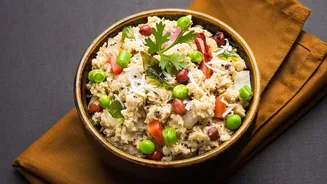






The Frustration of Lumpy Upma
It’s a familiar scene in many Indian kitchens. You’re making a quick, comforting bowl of upma, but the moment the rava (semolina) hits the hot water, disaster strikes. Clumps form instantly, and no amount of frantic stirring seems to break them down.
The result is a dish that’s part-pasty, part-gritty, and a far cry from the soft, uniform texture you were hoping for. This common problem has led many to believe that making good upma is an art form reserved for seasoned experts. But the solution isn't about some hidden family secret; it's about understanding the simple science of what’s happening in your pan.
Understanding Rava's Relationship with Water
Rava, also known as suji or semolina, is milled from durum wheat. Like other flours and grains, it is primarily composed of starch and protein. When these starch granules are introduced to hot water, a process called gelatinization begins. The granules absorb the liquid, swell up, and eventually soften, which thickens the mixture and gives upma its characteristic texture. However, semolina absorbs water more slowly than finer flours. If you dump the rava into the boiling water all at once, the granules on the outside of the pile get hydrated instantly. They swell rapidly and form a sticky, gelatinous barrier. This barrier prevents the water from reaching the dry rava trapped inside the clumps, leading to that undesirable lumpy texture. Adding rava too quickly is one of the most common reasons for sticky or uneven upma.
The Science of the Slow Pour
This is where the magic of the slow pour comes in. By adding the rava in a thin, steady stream with one hand while continuously stirring the boiling water with the other, you ensure that each grain is introduced to the hot liquid individually. This technique allows for even and gradual hydration. Each particle of rava can swell at a controlled pace without immediately sticking to its neighbors. Continuous stirring keeps the granules suspended and separated in the water, giving them the space to absorb moisture uniformly and preventing clumps from ever forming. It’s a simple act of patience that works with the physics of the ingredients, not against them.
Mastering the Perfect Technique
To execute the perfect pour, start by bringing your seasoned water to a rolling boil. Reduce the flame to low or medium-low to prevent aggressive splashing. Then, take your bowl of roasted rava and begin pouring it in a very slow, thin stream. As you pour, use a ladle or spoon in your other hand to stir the water in a constant circular motion. Don’t rush this step; the goal is to incorporate the rava so gradually that the water never stops simmering. You’ll see the mixture start to thicken almost immediately. Keep stirring until all the rava is added and the mixture is uniform. Once it's combined, you can cover the pan and let it steam on low heat for a few minutes to ensure every grain is perfectly cooked and fluffy.
Other Keys to Fluffy Upma
While the slow pour is crucial, a few other factors contribute to success. First, always dry roast your rava on a medium flame until it's aromatic and lightly toasted. This not only adds a nutty flavor but also helps prevent stickiness. Second, pay attention to your water ratio. A common starting point for a fluffy upma is a 1:2.5 or 1:3 ratio of rava to water, meaning for one cup of rava, you would use two and a half to three cups of water. Too little water can make it dry, while too much can result in a porridge-like consistency. Finally, letting the upma rest, covered, for about five minutes after cooking allows the steam to finish the job, making the final texture even lighter.