










How This New-Age Train Works
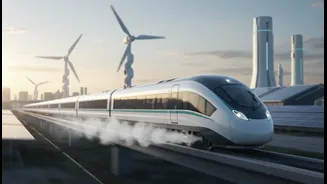
At its heart, a hydrogen train is an electric train that produces its own power on board. Instead of drawing electricity from overhead wires or burning diesel, it uses a fuel cell system. Inside the fuel cell, compressed hydrogen stored in tanks reacts
with oxygen taken from the air. This electrochemical reaction generates electricity to power the motors, with the only byproducts being heat and pure water vapour. Any excess electricity, including energy captured during braking, is stored in lithium-ion batteries for a power boost when needed. This technology offers the best of both worlds: the zero-emission benefit of electric trains without the need for costly and complex overhead power lines.
India's Landmark 'NaMo Green Rail' Project
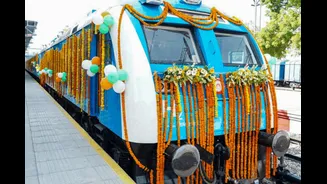
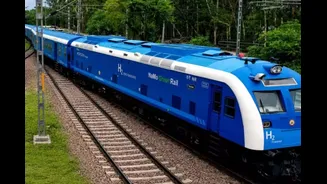
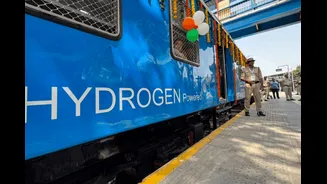
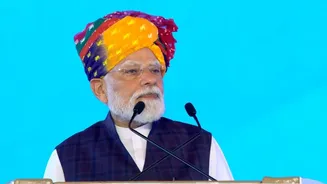
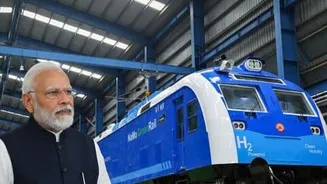
On July 17, 2026, Prime Minister Narendra Modi flagged off the 'NaMo Green Rail' on its inaugural journey between Jind and Sonipat in Haryana. This indigenous 10-coach train is not just a first for India; with a capacity of around 2,600 passengers, it is the world's longest hydrogen-powered passenger rail service. Operating on an 89-km stretch, the train was developed by retrofitting an existing diesel train, a project undertaken by Hyderabad-based Medha Servo Drives in partnership with Canada's Ballard Power Systems. This pilot is the first step in the ambitious 'Hydrogen for Heritage' initiative, which aims to run 35 such trains on scenic and ecologically sensitive routes, like the Kalka-Shimla line, to promote green tourism and preserve natural beauty.
Joining an Elite Global Club
With this launch, India joins a small but growing circle of nations pioneering hydrogen rail technology. Germany has been a frontrunner, launching the world's first commercial hydrogen passenger service in 2018 and since expanding its network. Other countries like China, Japan, France, and the United States are also actively running pilot projects or have limited deployments. However, many of these international projects involve smaller two- or three-coach trains for regional routes. India's debut with a full-length, high-capacity train demonstrates a significant commitment and a bold leap in technological capability on the world stage.
The Promise of a Greener Future
The push for hydrogen trains aligns perfectly with India's national goals. First and foremost is the environmental benefit. These trains offer a zero-emission alternative to diesel locomotives, which are still used on non-electrified parts of the network, helping to reduce air pollution and meet the country's target of becoming a Net Zero Carbon Emitter by 2030 for its railways. Economically, it supports the 'Make in India' initiative and can reduce the nation's massive diesel import bill. Strategically, mastering hydrogen technology is a crucial step towards energy independence and positions India as a leader in the global green hydrogen economy.
Challenges on the Track Ahead
Despite the promise, the journey is not without its hurdles. The primary challenge is cost. The Jind-Sonipat pilot project alone is estimated at over ₹111 crore, covering the train's retrofitting and the necessary ground infrastructure. A wider rollout under the 'Hydrogen for Heritage' scheme will require substantial investment, with each train costing around ₹80 crore and the supporting infrastructure another ₹70 crore per route. Furthermore, the safe production, storage, and transportation of hydrogen—a highly flammable gas—require stringent protocols and a new ecosystem of infrastructure that is currently limited in India. The real test will be ensuring the technology is not only clean but also reliable, efficient, and economically viable in the long run.