




The Planet's Engine Room
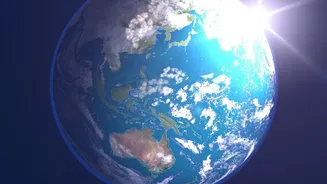
At the heart of this story is a vast expanse of ocean water known as the Indo-Pacific Warm Pool. It's the largest and warmest body of water on the planet, stretching across the western Pacific and eastern Indian Oceans. With surface temperatures consistently
above 28°C, it acts like a massive engine for the global climate, driving atmospheric circulation and weather patterns far and wide. Think of it as the source of immense heat and moisture, influencing everything from regional monsoons to global climate phenomena. Its location, bordering Southeast Asia and northern Australia, makes it a critical component of the weather systems affecting a huge portion of the world's population.
An Unexpected Ice Gain
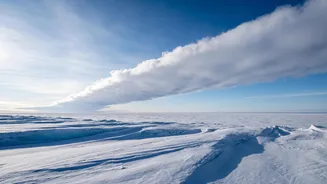
For decades, the story of Antarctica has been one of accelerating ice loss. The continent has been shedding ice at an average rate of about 140.5 billion tonnes per year, contributing significantly to global sea level rise. But between July 2021 and April 2023, something strange happened. Satellites observed a massive gain of ice, totalling around 695 billion tons, concentrated primarily in a region of East Antarctica. This was the largest short-term ice gain ever recorded by satellites since observations began in 2003. The immediate cause was exceptionally heavy and sustained snowfall, but the question for scientists was: what triggered this sudden reversal? The answer, it turns out, was thousands of kilometres away.
Connecting the Tropics to the Pole
The new study, published in the journal Nature, found that sustained and unusual warming in the Tropical Warm Pool from 2021 to 2023 was the underlying driver. This patch of extra-warm water set off a chain reaction in the atmosphere. It generated a massive, planetary-scale atmospheric wave, known as a Rossby wave train, which travelled southwards towards Antarctica. This wave reorganised wind patterns over the frozen continent, establishing a new circulation pattern that acted like a highway for moisture. It effectively steered moist air from the mid-latitude Indian Ocean directly towards East Antarctica, resulting in the persistent, heavy snowfall that piled up on the ice sheet. This long-distance link, where events in one part of the globe affect another, is what scientists call a 'teleconnection'.
Good News or a Complication?
While a gain of ice sounds like positive news, scientists are quick to put it in context. This event does not reverse the long-term trend of melting. The West Antarctic Ice Sheet, which is more vulnerable because much of it rests on bedrock below sea level, continued to lose mass during this period. This temporary gain in the East was a result of a specific, multi-year weather pattern, which occurs roughly once a decade. The study highlights the incredible complexity of the Earth's climate system, where a warming world can produce seemingly contradictory outcomes. It demonstrates that natural variability can still produce dramatic short-term effects that are superimposed on the long-term trend of human-caused climate change. The study's lead author, Yunhe Wang, referred to this as a previously underrecognized 'tropical warm pool-East Antarctic Ice Sheet' teleconnection pathway.
Why This Finding Matters
This discovery is crucial for several reasons. Firstly, it adds a new and important variable to the models that predict future sea level rise. Understanding how tropical ocean temperatures can influence Antarctic snowfall allows for more accurate projections. Secondly, it underscores just how interconnected our planet's systems are. Climate change isn't a simple, linear process of warming; it involves complex feedback loops and long-distance interactions that can yield surprising results. The warming of the Indo-Pacific Warm Pool, for instance, has already been linked to changes in weather oscillations that affect global rainfall patterns. This new link to Antarctic ice adds another layer to our understanding of its far-reaching influence. It is a powerful reminder that what happens in the tropical oceans, right on India's doorstep, can have profound consequences at the coldest, most remote place on Earth.