








A World Forged by Gravity
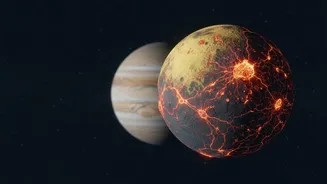
The secret to Io’s fury is a phenomenon called tidal heating. Unlike Earth, whose volcanoes are powered by heat from its initial formation and radioactive decay, Io is too small for that. Instead, its heat comes from a constant, violent gravitational
tug-of-war. Jupiter’s immense gravity pulls on Io, while the other large moons—Europa and Ganymede—pull from the other side. This celestial arm-wrestle forces Io into a slightly elliptical orbit. As it gets closer to Jupiter, it is stretched; as it moves away, it relaxes. Imagine squeezing a stress ball over and over—the repeated friction generates heat. On Io, this process is so extreme its surface can bulge up and down by 100 meters, generating incredible amounts of internal energy that must escape.
The Solar System's Fieriest Moon
The result of all this internal friction is a surface unlike any other. Io is home to over 400 active volcanoes, spewing plumes of sulfur and lava hundreds of kilometers into space. It is a world perpetually repaving itself, where ancient craters are buried under fresh volcanic flows. For decades, scientists have studied this extreme volcanism, first glimpsed by the Voyager spacecraft and later observed in detail by Galileo and, more recently, NASA's Juno probe. These missions confirmed that Io is the most geologically active object in our solar system, with a heat output many times greater than Earth's.
New Insights from Beneath the Crust
Until recently, our understanding of Io's heat was limited to what we could see on the surface with infrared instruments. But recent flybys by the Juno mission have changed the game. Using its Microwave Radiometer (MWR), Juno has peered beneath Io's crust for the first time. The data, published in mid-2026, revealed that temperatures rise dramatically just a few feet below the surface. This suggests a massive amount of heat is moving from the interior toward the surface, far more than solar heating alone could explain. According to Scott Bolton, Juno's principal investigator, these findings provide a unique window into how tidal heating works, allowing scientists to characterize how heat moves from the interior outwards.
A Blueprint for Worlds Beyond
This is why Io has become such a critical test case. The physics of tidal heating isn't unique to our solar system. Many exoplanets—worlds orbiting other stars—are in configurations where they could be experiencing similar gravitational forces. This process could be a vital source of energy, potentially keeping a world warm enough for liquid water even if it is far from its star's habitable zone. The icy moons in our own outer solar system, like Europa and Enceladus, are thought to have vast subsurface oceans kept liquid by this same mechanism. By studying Io, the most extreme example we can access, scientists can refine their models for what to look for elsewhere. Understanding how heat is generated and transported on Io helps researchers know what atmospheric and surface signatures to search for with telescopes like the James Webb Space Telescope when they examine distant exoplanets.
The Future of Tidal Exploration
The detailed data from Juno is just the beginning. It has not only confirmed the intensity of Io's internal engine but also provided a new tool—microwave radiometry—to study it. These new findings strengthen the case for a dedicated mission to Io, a long-held dream of many planetary scientists. Proposed concepts like the Io Volcano Observer (IVO) would aim to map the moon's heat flow in detail, determine if it has a global magma ocean, and revolutionize our understanding of how tidal forces shape a world. By thoroughly studying our solar system's most tortured moon, we can unlock secrets that apply across the cosmos, from the potential for life on icy ocean worlds to the nature of volcanic exoplanets light-years away.