



Kolkata carries many titles, but few are as evocative as the 'London of India'. This nickname points to a time when the city was the jewel of the British Empire, a legacy etched into its very skyline and grand boulevards.
Capital of the Raj
The story begins when Kolkata,
then Calcutta, was the capital of British India from 1772 to 1911. As the second most important city in the British Empire after London, it became a bustling hub for administration, commerce, and culture. The British sought to build a capital that reflected their imperial power, modelling its urban plan on European cities. Grand administrative buildings, wide roads, and stately institutions were constructed, creating an architectural landscape that mirrored London's grandeur. This transformation cemented its status not just as a political center, but as an open-air museum of monumental British architecture.
The Victoria Memorial: A Marble Masterpiece
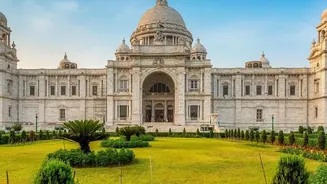
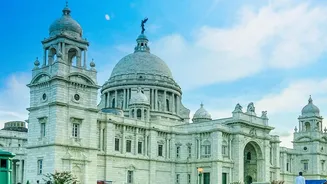
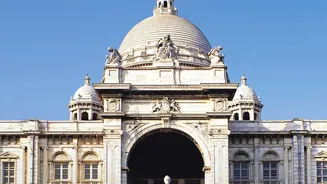
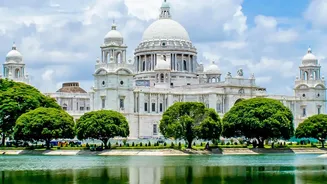
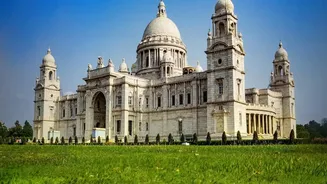
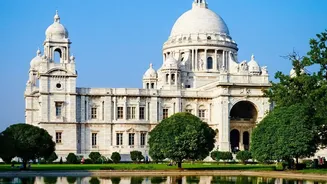
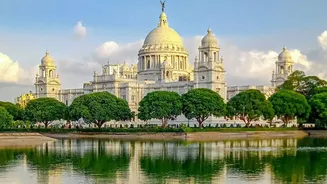
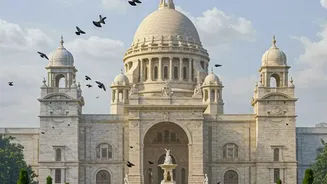
At the heart of Kolkata’s colonial identity is the Victoria Memorial, an iconic monument of white Makrana marble. Conceived by Lord Curzon after Queen Victoria’s death in 1901 and opened in 1921, it was intended to be a grand tribute to the Empress of India. Designed by architect William Emerson, the structure is a stunning example of the Indo-Saracenic style, blending British and Mughal architectural elements with Venetian and Egyptian details. With its soaring central dome, lush gardens, and resemblance to the Taj Mahal, the Victoria Memorial remains the city's most famous colonial landmark.
A Skyline of Colonial Grandeur
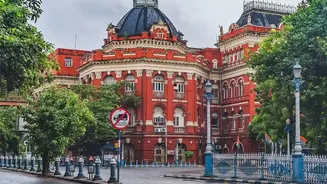
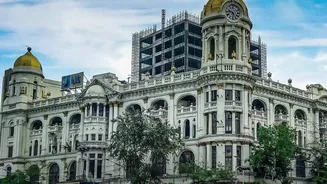
Beyond the Victoria Memorial, Kolkata's skyline is a rich tapestry of colonial-era buildings. St. Paul's Cathedral, consecrated in 1847, is a prime example of Gothic Revival architecture, designed to serve the growing European community. The Calcutta High Court, the oldest in India, was modelled on a Belgian cloth hall and showcases an impressive neo-Gothic style. The General Post Office, with its towering dome and Corinthian columns, and the Neoclassical Writers' Building further define the area once known as Dalhousie Square (now B.B.D. Bagh), the administrative core of the Raj.
The Cultural Echo of London
The comparison to London wasn't just architectural. The British established a cultural and social infrastructure that mimicked life in their capital. Elite social institutions like the Bengal Club, founded in 1827, became enduring fixtures of high society. The city developed a thriving arts and theatre scene, and educational institutions were founded that became centers of intellectual life. Even the city's geography, with its development along the Hooghly River as a major trade artery, drew comparisons to London's relationship with the River Thames. This fusion of administrative power, architectural ambition, and cultural replication solidified the city's London-esque reputation.
A Complicated Legacy Today
Today, the 'London of India' nickname is more a historical reference than a modern descriptor. While Kolkata has forged its own vibrant identity, the architectural legacy of the Raj is undeniable and carefully preserved. Unlike some places that erased colonial symbols, India has largely accepted these buildings as witnesses to history. These structures are not just relics; many remain in active use, housing government offices, courts, and museums. For Kolkatans and visitors alike, this architectural heritage is a living, breathing part of the city's unique character, a beautiful yet complex reminder of its journey through time.