







Cosmic Cannons and a Lingering Mystery
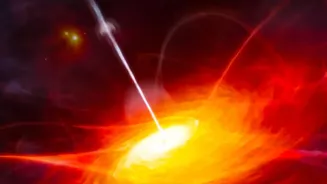
Black holes are famous for pulling things in, not shooting them out. Yet, some of the most powerful phenomena in the cosmos are the relativistic jets they produce. These are gargantuan streams of ionised matter and radiation, launched from near the black
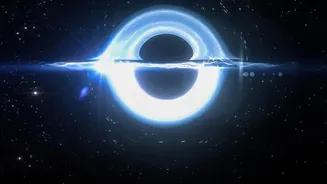
hole's poles at speeds approaching that of light. Supermassive black holes at the centres of galaxies create jets so vast they can influence the evolution of the entire galaxy. But a fundamental mystery has lingered: how exactly are these cosmic cannons loaded and fired? The physics happens in an environment so extreme and complex that it has been incredibly difficult to study directly. Scientists have theorised that twisted magnetic fields in the accretion disk—the swirling donut of matter waiting to be consumed by the black hole—play a crucial role, but observing the process in detail has been a challenge.
Meet the Microblazar
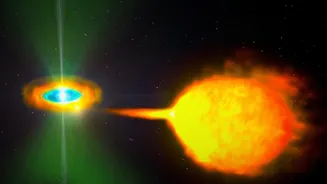
To understand the giants, sometimes you have to study the dwarfs. Astronomers have long studied blazars—a type of quasar where a supermassive black hole's jet happens to be pointed almost directly at Earth. This orientation makes them appear incredibly bright due to an effect called relativistic beaming. For decades, scientists theorised that a smaller version should exist: a microblazar. This would be a binary system containing a stellar-mass black hole (perhaps just a few times the mass of our sun) that is stripping material from a companion star. As that material falls toward the black hole, some of it is funnelled into jets, just like its supermassive cousins. If one of those jets were aimed at us, it would provide a 'cosmic laboratory' to study jet physics on a much more manageable and faster timescale.
A Candidate Emerges from the Dust
After a search spanning more than 30 years, astronomers have identified the strongest candidate yet for a microblazar in our own Milky Way galaxy. The system, named IRAS 18293-0941, is located about 12,000 light-years from Earth. It consists of a black hole about 10 times the mass of the Sun orbiting a massive companion star every 11 days. The object was catalogued decades ago but was largely overlooked because it is hidden behind a thick veil of interstellar dust, making it nearly invisible in optical light. However, using radio telescopes, scientists detected the tell-tale sign of a jet pointing almost directly at Earth, moving at an astonishing 75% of the speed of light. The illusion created by this orientation is so strong that the jet moving away from us is completely invisible.
A 'Rosetta Stone' for Black Hole Physics
The discovery of IRAS 18293-0941 is significant because it supports a key idea in astrophysics: that the physics of black holes is 'scalable'. This means the fundamental rules governing how they feed and launch jets might be the same, whether the black hole is ten times the mass of the sun or ten million. Recent studies of supermassive black holes have found they tend to launch jets when their feeding rate drops to about 2% of their theoretical maximum, a threshold that was already observed in smaller, stellar-mass black holes. Microblazars like this candidate allow scientists to watch these processes unfold on much shorter timescales—days and weeks instead of centuries or millennia. This provides a rare opportunity to test theories about how jets are launched, what they're made of, and how they stay so tightly focused over vast distances.