







A Monumental Surge in Numbers
The first quarter of the financial year 2026-27 has been transformative for India's electric vehicle export story. According to commerce ministry data, export earnings from electric cars skyrocketed to $369 million between April and June 2026. This represents
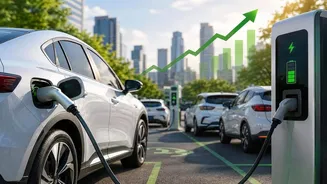
a staggering 16-fold increase from the $22.2 million earned during the same period last year. In terms of volume, shipments jumped more than eightfold, from 1,309 units to 10,802 vehicles. This exponential growth highlights a sharp rise in global demand and acceptance for EVs produced in India, firmly placing the nation on the world's sustainable mobility map. The impressive performance builds on a strong FY 2025-26, which saw annual EV exports hit $701 million, and the latest quarterly figures indicate a significant acceleration of this trend.
Europe's EV Appetite Leads the Way
The driving force behind this export boom is overwhelmingly European. The continent has become the principal destination for Indian electric cars, with Spain leading the charge. Spanish imports alone accounted for $146.4 million, representing nearly 40% of India's total electric car export value for the quarter. A total of 4,007 vehicles were shipped to Spain. The United Kingdom emerged as the second-largest market, with imports worth $78.7 million—a dramatic increase from negligible shipments in the previous year. The UK imported 2,646 Indian-made EVs, up from just a single vehicle in the same quarter last year. This growing footprint in some of Europe's most developed EV markets signals a major shift.
Why Europe is Buying 'Made in India'
Several factors are converging to make Indian EVs attractive to European buyers. Firstly, Europe's stringent emission standards and supportive government policies create a fertile ground for electric vehicles. Indian manufacturers are increasingly producing globally competitive models that meet the high safety and quality benchmarks demanded by these advanced economies. Secondly, there is a rising demand for affordable and efficient electric mobility solutions in Europe, a niche that Indian automakers are well-positioned to fill. The ability to move beyond traditional regional markets like Nepal and establish a presence in countries like Germany ($25.1 million), Norway ($21.1 million), and Denmark ($21 million) underscores the growing international competitiveness of the Indian auto industry.
A Broadening Global Footprint
While Europe is the headline act, the export growth is a global story. Indian EVs are also finding homes in other technologically advanced markets. During the same quarter, Japan imported $13.4 million worth of electric cars from India. Shipments were also recorded to Israel, Australia, Singapore, and South Korea, further demonstrating the improving quality and appeal of Indian products. This geographical diversification is crucial, indicating that the success is not reliant on a single region. The expansion into Latin American markets like Brazil and Colombia further cements India's role as an emerging, reliable manufacturing hub for the global EV supply chain. This widening footprint shows that India is successfully moving past its regional export comfort zone.
The Road Ahead and Potential Challenges
This export surge is a significant victory for the 'Make in India' initiative. However, sustaining this momentum will require navigating a complex landscape. Competition in the European market is fierce, particularly from established players and other ambitious exporters. Furthermore, evolving trade policies and regulations, such as the EU's Carbon Border Adjustment Mechanism (CBAM), could pose challenges for Indian exporters in the long run by potentially adding costs related to embedded emissions. Automakers will need to remain agile, continuing to invest in technology, localizing supply chains, and adapting to the dynamic regulatory environment of their key export markets. The significant increase in the average value per exported vehicle, from about $17,000 to $34,000, suggests a promising shift towards higher-value models, which could help fortify margins and brand positioning.