








Why Yoga Helps Your Gut
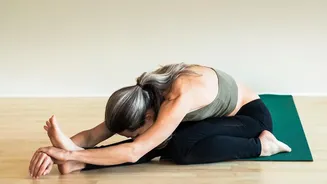
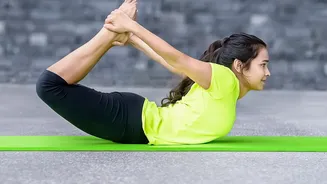
Before diving into the poses, it's helpful to understand why yoga is so effective for digestion. The practice works in several ways. Firstly, gentle movements like twists and forward folds act as an internal massage for your abdominal organs. This compression
and release can stimulate blood flow to the digestive tract and encourage the movement of contents through your system. Secondly, yoga is a powerful tool for stress reduction. Stress is a known disruptor of digestion, and by activating the body's 'rest and digest' system (the parasympathetic nervous system), yoga helps create the calm internal state necessary for optimal gut function. Finally, specific poses can help relieve common issues like bloating and trapped gas by physically helping to move it through the intestines.
Cat-Cow Pose (Marjaryasana-Bitilasana)
This is a classic warm-up that gently wakes up the spine and stimulates the abdominal organs. Start on your hands and knees in a tabletop position, with your wrists directly under your shoulders and knees under your hips. As you inhale, drop your belly towards the mat, lift your chest and tailbone, and look forward into Cow Pose. As you exhale, round your spine towards theceiling, tuck your chin to your chest, and gently draw your navel inwards, creating a gentle squeeze for your organs in Cat Pose. Flow between these two movements for 8-10 breaths, coordinating the motion with your breath.
Seated Spinal Twist (Ardha Matsyendrasana)
Twists are fantastic for digestion because they 'wring out' the digestive organs, boosting circulation and helping to eliminate toxins and waste. Sit on the floor with your legs extended in front of you. Bend your right knee and place your right foot on the floor on the outside of your left thigh. You can keep your left leg straight or bend it in. Place your right hand on the floor behind you for support. Inhale to lengthen your spine, and as you exhale, twist your torso to the right, hooking your left elbow on the outside of your right knee. Hold for 5-8 breaths, then gently release and repeat on the other side. A helpful tip is to twist to the right first to compress the ascending colon, and then left to compress the descending colon, following the natural path of digestion.
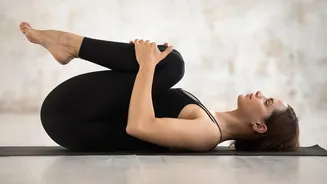
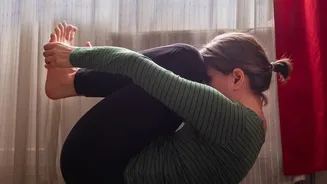
Wind-Relieving Pose (Pawanmuktasana)
The name says it all. This pose is one of the most effective for relieving bloating and trapped gas. Lie on your back with your legs extended. As you exhale, draw both knees into your chest and wrap your arms around your shins, giving yourself a gentle hug. You can keep your head on the floor or lift your head and shoulders slightly to bring your nose toward your knees for a deeper compression. Hold for 30 to 60 seconds. For an added massage effect on the colon, you can rock gently from side to side.
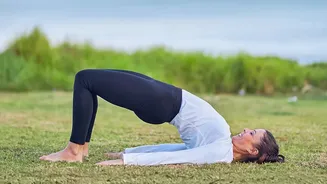
Bridge Pose (Setu Bandhasana)
Bridge Pose creates a gentle compression in the abdomen as you lift, followed by a release as you lower, which can help stimulate digestive organs. Lie on your back with your knees bent and feet flat on the floor, hip-width apart. Your arms should be resting alongside your body with palms facing down. Press into your feet and lift your hips off the floor. Interlace your fingers underneath your back if it's comfortable. The pose also helps activate the vagus nerve, which plays a key role in gut motility and the body's relaxation response. Hold for 5 breaths, then slowly lower your spine back to the floor one vertebra at a time.
Supine Spinal Twist (Supta Matsyendrasana)
This is a restorative and relaxing twist that helps release tension in the spine and abdomen, enhancing circulation to your digestive organs. Lie on your back and draw your knees into your chest. Extend your arms out to the sides at shoulder level, like a 'T'. As you exhale, let both knees fall gently to your left side. Turn your head to gaze over your right shoulder. Try to keep both shoulders grounded on the floor. Breathe deeply into your belly for 5-10 breaths before returning to the center and repeating on the other side.