


The Father of Modern Rocketry
Robert H. Goddard, a physics professor from Worcester, Massachusetts, was a man possessed by a singular, audacious dream: reaching space. Inspired as a teen by H.G. Wells' novel "The War of the Worlds," he dedicated his life to solving the problem of spaceflight.
At the time, this was the stuff of science fiction. The scientific establishment was deeply skeptical, and the press often treated his ideas with ridicule. A 1920 New York Times editorial famously mocked Goddard, suggesting he lacked the basic high school knowledge of physics for believing a rocket could work in the vacuum of space. Undeterred, Goddard quietly persevered, convinced that the key was not the solid-fuel powders used in fireworks for centuries, but powerful and controllable liquid propellants.
A Lonely and Dangerous Pursuit
Goddard's work was revolutionary, but also isolating and dangerous. He began experimenting with liquid oxygen and gasoline in 1921, a volatile combination that required immense technical precision. For years, he worked with a small, dedicated team, often funding his research with modest grants from institutions like the Smithsonian. His 1919 publication, "A Method of Reaching Extreme Altitudes," laid out the theoretical groundwork, but turning theory into practice was a painstaking process of trial and error. He developed patents for multi-stage rockets and liquid-fuel systems as early as 1914, concepts that would become fundamental to spaceflight decades later. Yet, to the outside world, he was the 'moon man,' an eccentric professor chasing an impossible dream.
A Flight of 2.5 Seconds
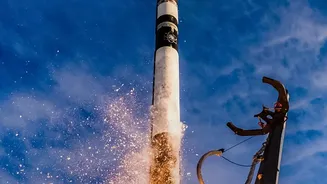
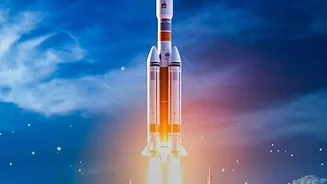
On the cold morning of March 16, 1926, on his Aunt Effie’s farm in Auburn, Massachusetts, history was made with little fanfare. Goddard and his small team mounted his rocket, which he nicknamed "Nell," on its launch frame. The design looked strange by modern standards, with the engine and nozzle placed at the top of the rocket, an arrangement Goddard thought would be more stable. After ignition, the rocket lifted off, soared to an altitude of 41 feet—about the height of a four-story building—and flew for 2.5 seconds before landing 184 feet away in a frozen cabbage field. There were no cheering crowds or banner headlines. It was a brief, almost anticlimactic event, but its significance was immeasurable.
Why It Changed Everything
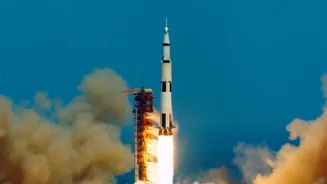
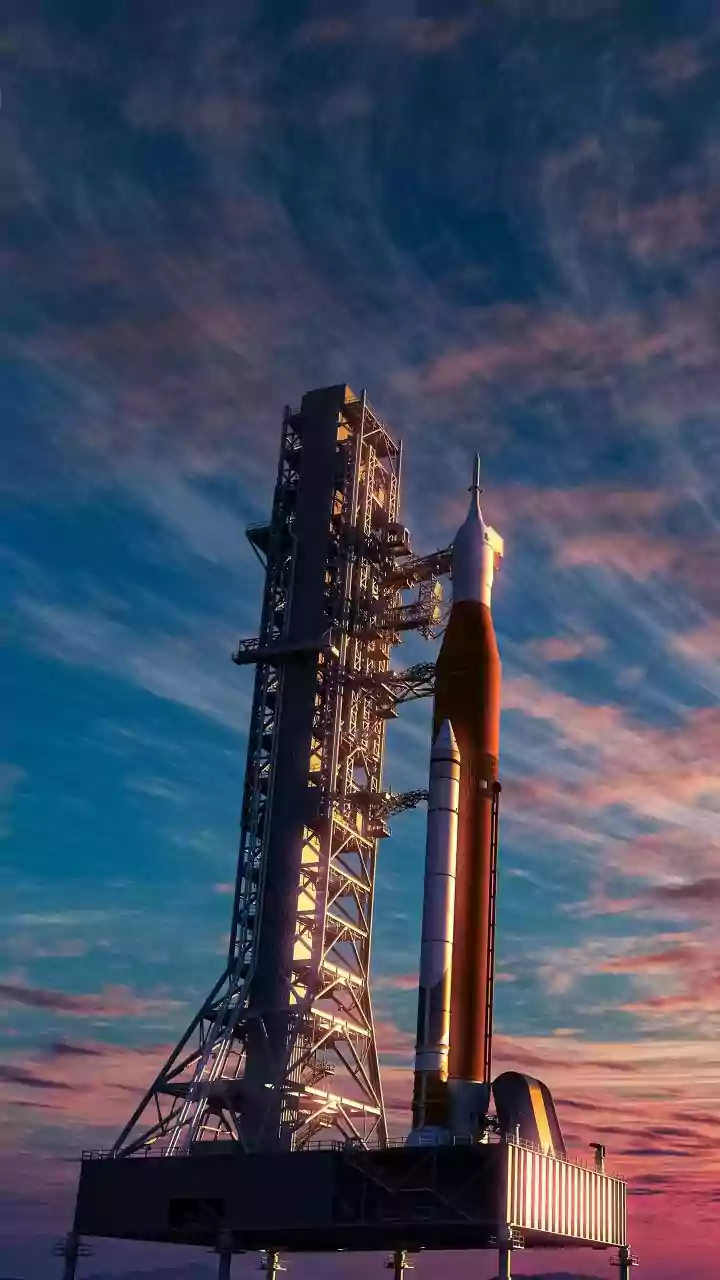
The success of Goddard's flight wasn't about the altitude or duration; it was about the method. For the first time, a rocket powered by liquid fuel had achieved flight. Unlike solid fuel, liquid propellants could be controlled. The flow of fuel could be throttled to increase or decrease thrust, and the engine could even be shut down and restarted. This control was the missing ingredient for practical, high-altitude rocketry. Goddard's creation, though primitive, contained the essential DNA of every major rocket that would follow, from the German V-2 to the gigantic Saturn V that carried astronauts to the Moon. The basic technology behind that 4.5 kg rocket was the same used to launch the 2.7 million kg Saturn V. He had proven that the dream was possible.
From a Farm to the Moon
While Goddard's breakthrough went largely unnoticed by the public, it captured the attention of influential figures like famed aviator Charles Lindbergh, whose support helped secure crucial funding for Goddard's continued research in the clearer, wide-open spaces of Roswell, New Mexico. Over the next decade, he and his team launched 34 more rockets, developing key technologies like gyroscopic stabilization, moveable vanes for steering, and parachute recovery systems. Though much of his work was underappreciated in the United States during his lifetime, his patents and research became foundational for rocket programs around the world. NASA's Goddard Space Flight Center was later named in his honor, a fitting tribute to the man who took the first small step. Years later, on the eve of the Apollo 11 moon landing in 1969, The New York Times issued a famous correction, regretting its earlier mockery of his work.