

A New Window on the Cosmos
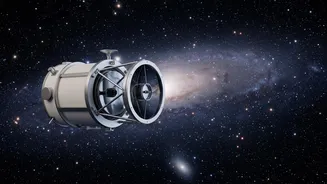
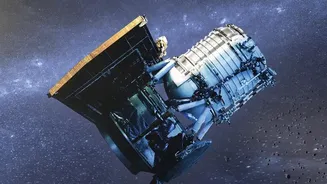
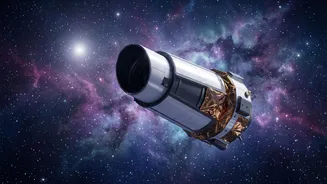
Launched on August 30, 2026, the Nancy Grace Roman Space Telescope is the next great observatory in NASA's fleet, following iconic missions like Hubble and the James Webb Space Telescope (JWST). Named after Dr. Nancy Grace Roman, NASA's first chief of
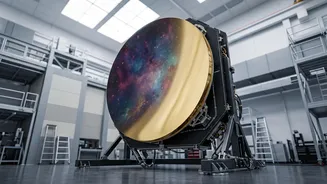
astronomy and the “Mother of Hubble,” this mission is designed to tackle some of the biggest questions in astrophysics. It journeyed to a stable orbit 1.5 million kilometers from Earth, a vantage point that allows for uninterrupted views of the universe. At its heart is a 2.4-meter primary mirror—the same size as Hubble's—but paired with an instrument that gives it a truly game-changing capability.
Seeing the Bigger Picture
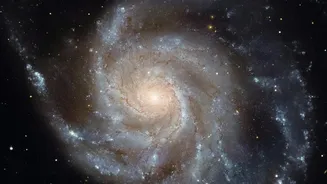
The defining feature of the Roman telescope is its immense field of view. Its Wide-Field Instrument (WFI) can capture an area of the sky at least 100 times larger than Hubble can in a single snapshot, all while maintaining similar image sharpness. Where Hubble might see a handful of galaxies, Roman will see millions. This turns the telescope into a powerful survey machine. Instead of taking long, narrow peeks into the cosmos, Roman will create enormous panoramic images, mapping vast swathes of the sky with incredible speed and efficiency. To cover an area of the sky that Roman can capture in just two images, Hubble would need to take over 430 separate pictures. This massive scale is what allows the mission to study celestial objects by the millions, providing an unprecedented statistical power to astronomers.
Hunting for Dark Energy
One of Roman's primary goals is to unravel the mystery of dark energy, the enigmatic force causing the universe to expand at an accelerating rate. By imaging hundreds of millions of distant galaxies, Roman will map the structure of the cosmos through space and time. It will use three different methods to probe dark energy's effects: measuring the subtle warping of light from distant galaxies (weak gravitational lensing), tracking the distribution of galaxies (baryon acoustic oscillations), and observing thousands of distant exploding stars called supernovae. This multi-pronged attack will provide the most detailed look yet at the history of the universe's expansion, helping scientists determine if dark energy is a constant force or if it has changed over cosmic history.
A Census of Distant Worlds
Beyond cosmology, Roman is poised to revolutionize the hunt for exoplanets—planets orbiting other stars. While missions like Kepler stared at one patch of sky, Roman will conduct a massive survey of the inner Milky Way, monitoring 200 million stars. Its primary method for finding planets is gravitational microlensing, a technique that can detect the tiny brightening of a star when a planet passes in front of it, acting like a cosmic magnifying glass. This method is sensitive enough to find planets down to the mass of Mars and even free-floating 'rogue' planets that don't orbit a star at all. Scientists anticipate Roman will discover over 100,000 new exoplanets, vastly increasing the known number of worlds in our galaxy and providing a statistical census of their populations.
A Data Trove for a New Era
Roman's ability to see so much, so quickly, means it will generate a staggering amount of information—an estimated 1.4 terabytes of data every single day. This firehose of data will be made available to the worldwide astronomy community, enabling discoveries far beyond the mission's core objectives. At least a quarter of Roman's observing time is set aside for general astrophysics programs, allowing scientists to propose their own investigations. It is not a replacement for Hubble or JWST but a powerful partner. Roman's wide-angle surveys will identify countless fascinating objects and phenomena, creating a catalog for other telescopes to study in more detail. This collaborative approach will help usher in a new era of large-scale, data-driven astronomy, changing not just what we see but how we see the universe.