




Our Solar System's Cosmic Shield
Imagine a giant bubble inflated by the Sun. This isn't science fiction; it’s the heliosphere. The Sun constantly releases a stream of charged particles called the solar wind, which travels outwards at over a million miles per hour, far past the orbit
of Neptune. This solar wind carves out a massive cavity in the interstellar medium—the gas and dust that fills the space between stars. This bubble, the heliosphere, acts as our solar system's primary defence against galactic cosmic rays. These are highly energetic particles, often blasted from distant supernovae, that could otherwise bombard Earth, damage DNA, and strip away our atmosphere over time. While Earth’s own magnetic field provides a crucial second layer of defence, the heliosphere is the first and largest barrier protecting all the planets within it.
Introducing NASA’s Celestial Cartographer
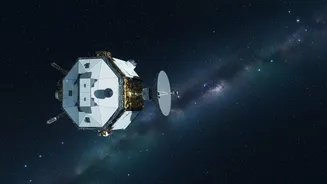
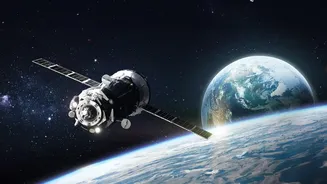
To study this invisible shield, NASA launched the Interstellar Mapping and Acceleration Probe, or IMAP, on September 24, 2025. Led by a team at Princeton University, this modern-day celestial cartographer is on a mission to map the precise boundaries of our heliosphere. The spacecraft is strategically positioned about one million miles from Earth towards the Sun, at a gravitational balance point known as L1. From this vantage point, its ten sophisticated instruments can intercept and analyze particles streaming from the Sun, as well as those that manage to travel in from interstellar space. The mission’s two main goals are to understand how the solar wind interacts with the galactic neighbourhood and to study how particles are accelerated to such high speeds throughout our solar system.
The First Data from the Frontier
In late July and early August 2026, the IMAP mission team made its first major set of scientific data publicly available. This release marks a pivotal moment, moving beyond the initial instrument tests to the core scientific phase of the mission. Scientists can now dive into the information gathered by instruments like IMAP-Ultra, which is designed to see what happens when the solar wind collides with the interstellar medium. The key to this is detecting 'energetic neutral atoms' (ENAs). These particles are born at the solar system's edge when hot solar wind particles snatch an electron from the cold, neutral gas of interstellar space. Because they are now neutral, these ENAs are no longer affected by magnetic fields and travel in straight lines. Some of them fly all the way back toward Earth, where IMAP can catch them. By tracing their paths, scientists can construct the first comprehensive, 3D map of the heliosphere's boundary.
Why This Cosmic Map Matters
Understanding the heliosphere isn't just an academic exercise; it has practical implications for us on Earth. The strength and size of the heliosphere fluctuate with the Sun's 11-year activity cycle. When the Sun is more active, the bubble expands, offering more protection. When it's quieter, it shrinks, allowing more galactic cosmic rays to enter the solar system. For future long-duration space missions to the Moon or Mars, astronauts will be outside the protection of Earth's magnetic field, relying solely on the heliosphere to shield them from this radiation. Furthermore, IMAP also functions as an advanced space weather beacon. Its I-ALiRT system provides near real-time data on the solar wind heading our way, offering forecasters about a 30-minute advance warning of potentially harmful solar particle events that can endanger satellites, disrupt power grids, and affect astronauts in orbit.
Just the Beginning of the Journey
This first data release is just the start of IMAP's two-year primary science mission. As the spacecraft continues to gather information, its maps will become more detailed, and our understanding of our cosmic neighbourhood will deepen. The mission builds on the legacy of spacecraft like the Voyager probes, which have actually crossed the heliosphere's boundary, and the Interstellar Boundary Explorer (IBEX), which provided the first-ever sky maps using ENAs. IMAP's instruments are more advanced, capable of collecting data across a wider range of energies and with greater precision, promising to solve long-standing mysteries about the heliosphere's shape and dynamics. By studying our own star's sphere of influence, scientists can also learn more about the conditions around distant stars and what it takes for a planet to be habitable.