







Enhances Proprioception and Body Awareness
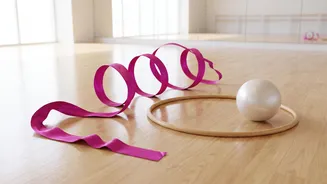
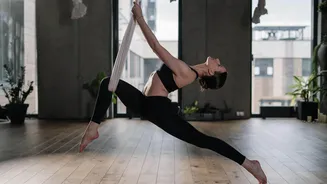
At its core, the mind-body connection relies on proprioception—your brain's ability to sense your body's position and movement in space. Rhythmic gymnastics elevates this to an art form. Gymnasts are constantly manipulating apparatuses like ribbons, hoops,
or balls while executing complex leaps, turns, and balances. This requires an intense, continuous dialogue between the brain and the body. To successfully catch a club thrown mid-air or roll a ball seamlessly across the back, a gymnast must have a highly refined internal map of their body. This constant feedback loop sharpens body awareness, making movements more precise, coordinated, and intuitive both on and off the mat.
Cultivates Deep Focus and Mindfulness
A rhythmic gymnastics routine is a whirlwind of coordinated actions that demand total concentration. Gymnasts must memorize intricate choreography, synchronize their movements with music, and manage an apparatus, all at once. This intense level of divided attention leaves no room for a wandering mind, effectively creating a state of moving meditation. The focus required to keep a ribbon from tangling or to execute a perfect series of turns trains the brain to remain in the present moment. This practice of mindfulness under physical pressure helps build mental acuity and concentration skills that are beneficial in all aspects of life, from academics to the workplace.
Fosters Emotional Expression Through Movement
Rhythmic gymnastics is as much an art as it is a sport. Routines are not just a series of physical feats; they are stories told through movement, set to music. Gymnasts are encouraged to interpret the music and convey a range of emotions, from joy and grace to sorrow and power. This process bridges the gap between internal feelings and external physical expression. Learning to channel emotions into movement helps athletes develop emotional intelligence and self-awareness. It provides a constructive outlet for self-expression, building confidence and empowering gymnasts to connect their inner world with their physical actions in a deeply personal and fulfilling way.
Builds Discipline and Mental Resilience
Mastering the skills of rhythmic gymnastics is a long-term journey that requires immense discipline, patience, and resilience. The process of learning a difficult new skill involves repetition, goal-setting, and overcoming frequent setbacks. This structured training builds a powerful mental framework. When a gymnast finally masters a routine that once seemed impossible, they are not just celebrating a physical achievement; they are internalizing the lesson that perseverance pays off. This builds self-discipline and the mental toughness to push through challenges. The mind learns to guide the body through frustration and fatigue, strengthening the connection between willpower and physical execution.
Sparks Creativity and Cognitive Flexibility
While rhythmic gymnastics is a sport of precision, it is also one of immense creativity. Choreographing routines, selecting music, and improvising movements all engage the creative, right side of the brain. Gymnasts are challenged to think creatively and solve physical problems, such as how to transition smoothly between elements or how to express a particular theme through their performance. This constant need to adapt, plan, and create enhances cognitive flexibility—the brain's ability to switch between different concepts and adapt behavior to achieve goals. It's a mental workout that complements the physical one, ensuring the mind-body connection is not just strong, but also adaptable and inventive.