









The Billion-Dollar Splashdown
For decades, launching a satellite meant building a massive, multi-story rocket, using it once, and letting its most expensive parts fall into the ocean or burn up in the atmosphere. It was the equivalent of flying a plane from Mumbai to Delhi and then
throwing the plane away. The modern space age is being defined by a radical shift away from this model. Reusability—the ability to recover, refurbish, and relaunch rocket components—has fundamentally altered the economics of space access. By reusing the first-stage booster, the largest and most powerful part of the rocket, companies can slash launch costs, increase flight frequency, and make space far more accessible for a range of commercial and scientific missions.
Agnikul's Ambitious Blueprint
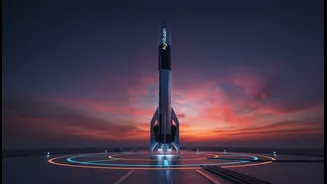
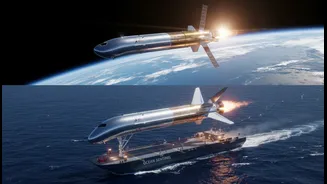
Agnikul Cosmos, an IIT Madras-incubated startup, is aiming to become India's first private company to achieve this feat. Following the successful suborbital test flight of its Agnibaan SOrTeD (Suborbital Technological Demonstrator) in May 2024, the company has set its sights on a far more complex objective for its next orbital mission. The plan for 'Mission 02' is two-fold: the primary goal is to deliver customer satellites into orbit, but a crucial secondary objective is to recover the rocket's first stage. The booster will be equipped with landing legs, grid fins for steering during atmospheric reentry, and its own flight computer to guide it to a powered vertical landing on a barge in the Bay of Bengal. This is a technically demanding maneuver that requires precision engineering across propulsion, guidance, and avionics.
More Than Just a Booster
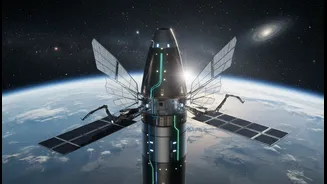
Agnikul’s plan for maximising value doesn’t end with the booster. The company is also designing its upper stage to be a 'convertible' platform. Traditionally, after releasing its payload, the upper stage of a rocket becomes hazardous space debris. Agnikul intends for its upper stage to remain functional in orbit, capable of serving as a platform for further experiments or commercial services. This innovative approach aims to extract revenue from every part of the launch system. Agnikul has already secured patents for this convertible upper-stage architecture in India, the US, and Europe, signaling its global ambitions.
The Indian Private Space Race
Agnikul is not alone in this pursuit. The race for reusability is heating up within India's burgeoning private space sector, which has grown to include over 400 startups since the sector was opened to private participation in 2020. Competitor Skyroot Aerospace is also developing reusable technology for its Vikram series of rockets. This friendly rivalry is set to accelerate innovation and could see a private Indian company master reusability even before the national space agency, ISRO, which is developing its own, much larger Next Generation Launch Vehicle. The recent addition of former ISRO Chairman S. Somanath to Agnikul's board as an observer underscores the national significance of this mission.
Challenges and the Road Ahead
While the ambition is clear, the path is fraught with challenges. Controlled, powered landings of rocket boosters are notoriously difficult and have been mastered by only a handful of players globally. The technology requires additional hardware and fuel, which adds weight and reduces the rocket's payload capacity for a given mission. However, Agnikul's CEO Srinath Ravichandran has stated that the economic benefits of successful reuse, which could cut launch costs by up to 80%, far outweigh the initial payload penalty. Confidence gained from their suborbital flight has prompted the team to pursue recovery immediately. While a firm launch date for Mission 02 has not been set, it is targeted for the current year, making it one of the most anticipated events in Indian spaceflight.