
The Sun’s Hidden Danger
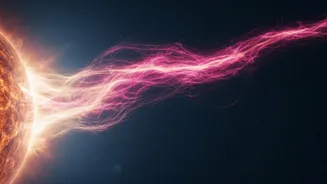
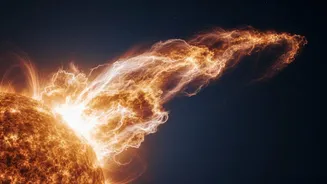
The Sun, our life-giving star, has a volatile side. It occasionally unleashes massive explosions of plasma and magnetic fields called coronal mass ejections, or CMEs. When a CME hurtles toward Earth, it can trigger a geomagnetic storm, a major disturbance
of our planet's magnetic field. While these storms produce beautiful auroras, they also pose a significant threat to our technology-dependent society. They can induce powerful currents in power grids, potentially damaging transformers and causing widespread blackouts. They can also disrupt radio communications, degrade GPS accuracy, and damage the sensitive electronics on which thousands of satellites rely.
Enter the PUNCH Mission
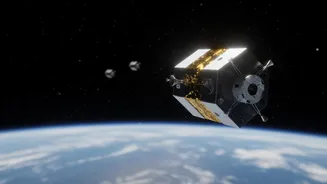
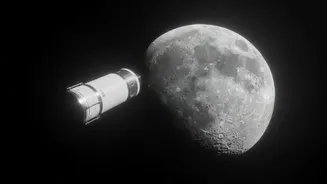
For years, predicting exactly when and if a CME would impact Earth has been a major challenge. Scientists could often see a CME leave the Sun but would lose track of it across the vast 150 million-kilometer journey to our planet. That all changed with NASA’s PUNCH mission, which stands for Polarimeter to Unify the Corona and Heliosphere. Launched in March 2025, PUNCH consists of four suitcase-sized satellites flying in formation. Together, they act as a single, giant observatory, providing a continuous, wide-field view of the space between the Sun and Earth. For the first time, scientists can track a CME's entire journey.
A Breakthrough in Forecasting
The latest breakthrough comes from a test where scientists fed PUNCH's detailed imagery of a past CME into a new computer model. By tracking the storm's shape and speed over time, the model was able to retroactively 'forecast' its arrival at Earth. The result was stunning. The model predicted the storm's arrival to within a 30-minute window. This represents a monumental leap in accuracy compared to previous methods, which could have error margins of five hours or more. As one lead scientist noted, it’s like going from a steam engine to a modern internal combustion engine for space weather forecasting.
What Faster Warnings Mean for Us
An accurate, early warning is not just a scientific achievement; it's a critical tool for protecting our infrastructure. Reducing the forecast uncertainty from many hours to just half an hour is a game-changer. With a reliable and timely warning, power grid operators can take preventative measures to protect their systems from damaging electrical currents. Satellite operators can put their spacecraft into a protective 'safe mode' to shield sensitive electronics. Airlines can reroute flights to avoid areas with communication disruptions and increased radiation. This new capability allows authorities to move from a state of general awareness to taking specific, targeted actions to mitigate the worst effects of a solar storm.