





Beyond Bigger Storms
For years, the climate change narrative around rainfall has been straightforward: a warmer atmosphere holds more moisture, leading to more intense downpours. This principle, that for every degree Celsius of warming the air’s water-holding capacity increases
by about 7%, explains why we see more frequent and severe flooding events globally. But this is only half the story. Scientists now understand that climate change is not just turning up the volume on rainfall; it is also changing the station. The very systems that steer weather around the globe are being altered, causing precipitation to shift from regions that have relied on it for centuries to new areas altogether.
The Science of Shifting Skies
The engine driving this great relocation is the disruption of large-scale atmospheric circulation patterns. Think of these as massive rivers of air in the sky, like the jet stream, which guide storms and weather systems. Global warming doesn't heat the planet evenly; the poles are warming faster than the equator. This reduces the temperature difference that powers these atmospheric rivers. As a result, these steering currents can weaken, shift, or meander in unpredictable ways. This can cause weather systems to stall, leading to prolonged droughts in one area or relentless rain in another. It means the rain isn't just heavier when it falls; it's falling in places, and at times, that defy historical patterns.
India’s Monsoon in Flux
Nowhere is this shift more critical than for the Indian monsoon, the lifeblood of the subcontinent's agriculture and economy. Studies indicate that the once-reliable rhythm of the monsoon is becoming dangerously erratic. Research from institutions like the Council on Energy, Environment and Water (CEEW) shows a clear trend: traditionally rainy areas in the Indo-Gangetic plains and the Northeast are experiencing a decrease in rainfall. At the same time, historically drier regions in Rajasthan, Gujarat, and parts of Maharashtra and Tamil Nadu are seeing an increase in southwest monsoon rainfall. This doesn't mean these dry areas are becoming lush oases. Instead, the rain that does fall is often delivered in short, destructive bursts, rather than the steady, soil-soaking drizzles that agriculture depends on.
A Tale of Two Extremes
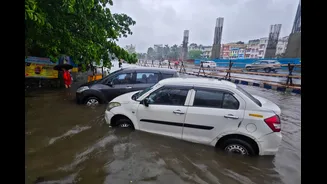
The consequences of this relocation are creating a paradox of simultaneous, but geographically separate, droughts and floods. One region's gain in rainfall is often another's loss, leading to a cascade of problems. A farmer in the Gangetic plains might see their crops fail due to a lack of rain, while a city on the west coast experiences unprecedented flooding that overwhelms its drainage systems. According to recent analysis, 55 per cent of India's tehsils saw an increase in southwest monsoon rainfall over the last decade, while 11 per cent saw a decrease. This volatility makes water management a nightmare. Reservoirs designed based on historical inflow patterns may not fill, while others are forced to release water to prevent catastrophic dam failure, causing downstream flooding.
Recalibrating Our Future
This new understanding forces a fundamental rethink of how we approach climate adaptation. Simply building higher flood walls or digging deeper wells is no longer enough. The problem is not just one of quantity but of timing and location. India's national and state-level planning must now account for a future where rainfall distribution is highly variable and unpredictable. This includes investing in advanced weather forecasting, developing drought-resistant crop varieties, promoting water-efficient irrigation, and designing cities with resilient infrastructure that can handle both extreme deluges and prolonged dry spells. The challenge is no longer just about managing extremes, but about adapting to a completely new and shifting climate reality.