






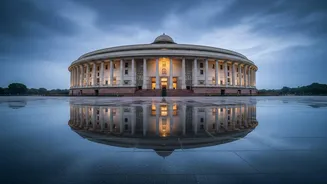

The Astonishing Price of Disruption
The most frequently cited figure for the cost of running Parliament is a staggering Rs 2.5 lakh per minute. This number, though sometimes based on older calculations, remains a powerful benchmark for the financial impact of a stalled session. This translates
to roughly Rs 1.5 crore per hour and can exceed Rs 9 crore for a standard six-hour working day. These costs don't simply vanish when the houses are adjourned. They cover a vast range of fixed expenses, including salaries and allowances for MPs and staff, building maintenance, utilities like electricity and water, and extensive security arrangements. In 2021, one parliamentary impasse was estimated to have cost the taxpayer around Rs 133 crore. Another analysis estimated that between 2014 and 2024, over Rs 3,300 crore was effectively wasted on lost time due to disruptions and political gridlock.
Productivity Lost, Bills Delayed
Beyond the crores, the real casualty of a washout is legislative work. Parliament's primary role is to legislate, debate policy, and hold the government accountable. Every hour lost to sloganeering is an hour not spent discussing crucial bills that affect the economy, social fabric, and governance. For instance, the Monsoon Session of 2025 saw its productivity plummet, with the Lok Sabha functioning for only 29% of its scheduled hours and the Rajya Sabha for 34%. This has a direct impact on the legislative pipeline. Important bills can be delayed for months or even years. Some are passed with minimal or no discussion at all, undermining the very purpose of parliamentary scrutiny. In one session, a bill concerning sexual harassment was reportedly passed in just 16 minutes. This trend of passing legislation amid din is a recurring issue.
The Logjam of Stalled Legislation
The list of delayed legislation serves as a stark reminder of the long-term consequences. In the past, crucial economic reforms like the Goods and Services Tax (GST) were delayed for years, with experts suggesting the delay cost the country in GDP growth. More recently, disruptions have threatened to stall key proposals, including bills to amend the registration of births and deaths, increase the number of Supreme Court judges, and restructure higher education. Even constitutional amendments, which require careful deliberation, get caught in the crossfire. A bill linked to increasing Lok Sabha seats for the implementation of women's reservation has also faced potential delays due to lost working hours. These are not abstract legal documents; they are instruments of governance that can affect everything from judicial efficiency to educational standards.
The Unseen Democratic Deficit
Perhaps the most surprising and damaging cost is the erosion of democratic norms. Parliament is the forum for the people's representatives to ask questions of the government during Question Hour, raise matters of public importance during Zero Hour, and debate the merits of policy. When sessions are repeatedly washed out, these fundamental accountability mechanisms fail. The Monsoon Session of 2025, for example, saw the Question Hour, a critical tool for scrutiny, function for only 23% of its scheduled time in the Lok Sabha and a dismal 6% in the Rajya Sabha. This not only weakens the Opposition's ability to hold the government accountable but also fosters a belief that dialogue can be replaced by disruption. Over time, this damages the credibility of the institution itself in the eyes of the public.
Why It All Matters to You
It is easy to view parliamentary standoffs as distant political theatre, but the effects ripple outwards. A delayed bill on judicial reforms means the justice system remains slow. A stalled infrastructure policy can impact the roads you travel on and the services you receive. When a bill to support small and medium enterprises is passed without adequate discussion, it might fail to address the core problems faced by millions of business owners. The declining number of sitting days—from an average of 135 days a year in the first Lok Sabha to just 55 in the 17th—means less time is dedicated to solving the nation's problems. Ultimately, the cost of a parliament washout isn't just a number on a balance sheet; it's a measure of lost opportunity and a weakened democracy that affects every citizen's life.