




A Partnership Forged for a New Era
In early October 2026, NASA and the Department of Energy (DOE) signed a significant Memorandum of in Understanding (MOU) titled 'Accelerating American Leadership in Space Nuclear Power and Propulsion'. This isn't just another piece of government paperwork.
It formalizes and streamlines a collaboration between the agency that sends us to the stars and the agency that masters the atom. The 10-year agreement consolidates previous pacts and creates a seamless framework for everything from research and development to fuel production, testing, and mission integration for advanced space nuclear systems. This unified effort is designed to 'supercharge civil space exploration' and lay the foundation for what NASA Administrator Jared Isaacman calls the 'Nuclear-NASA era'.
Why Nuclear Power is Crucial for Space
For decades, solar panels have been the workhorse of space power. But for missions venturing far from the sun or operating in long periods of darkness, solar power has its limits. On the Moon, a single night lasts for 14 Earth days, making solar-dependent operations a massive challenge. For deep space missions to Mars and beyond, the sun's light becomes too faint to power complex spacecraft. Nuclear systems, however, provide a constant, reliable, and powerful source of energy regardless of sunlight. This includes both radioisotope power systems, which have reliably powered probes like Voyager for decades, and new, more powerful fission reactors that can generate electricity for habitats or propel rockets.
Powering a Permanent Moon Base
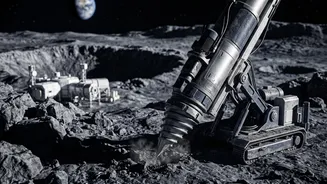
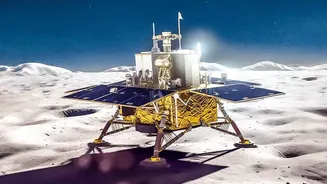
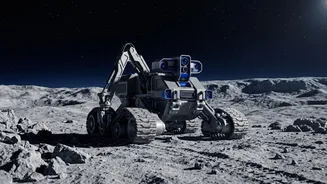
The agreement directly supports NASA's Artemis program, which aims to establish a sustained human presence on the Moon. A key goal is to develop and demonstrate a fission surface power system on the lunar surface by the early 2030s. NASA and the DOE are working with industry partners on designs for a small, 40-kilowatt class reactor that could operate for at least 10 years. A system like this would be a game-changer, providing the abundant, uninterrupted power needed to run habitats, conduct long-term science experiments, and utilize lunar resources, such as extracting water from ice deposits.
The Fast Lane to Mars
Perhaps the most exciting implication of this partnership is what it means for human missions to Mars. Current chemical rockets would require a transit time of seven to nine months each way. Such a long journey exposes astronauts to significant health risks from cosmic radiation and the physical and psychological tolls of deep-space travel. Nuclear Thermal Propulsion (NTP) could cut that travel time dramatically, potentially reducing the one-way trip to four or five months. NTP works by using a reactor to heat a propellant like hydrogen, creating a high-thrust, highly efficient engine. Another option, Nuclear Electric Propulsion (NEP), uses the reactor to generate electricity for ultra-efficient thrusters, which is ideal for hauling heavy cargo.
A Legacy of Collaboration, A Future of Discovery
While this new MOU marks a major step forward, the partnership between NASA and the DOE is built on a long history of success. For over 50 years, the DOE and its predecessors have provided the radioisotope power systems for 27 NASA missions, including the legendary Pioneer and Voyager probes and the Mars Perseverance rover. They also collaborated on early nuclear rocket research in the 1960s with Project Rover and the NERVA program. This new agreement leverages that long-standing trust, combining NASA's expertise in mission architecture with the DOE's unparalleled knowledge of nuclear science and safety. This ensures that as humanity pushes farther into the solar system, it does so with the safest and most reliable technology possible.