

A Celestial Lion
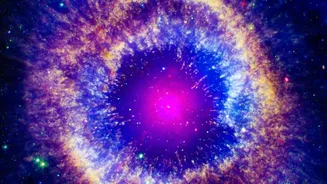
NGC 2392 is a planetary nebula, the glowing shell of gas and dust cast off by a star similar to our Sun at the end of its life. For decades, it was nicknamed the "Eskimo Nebula" due to its appearance through ground telescopes, resembling a face surrounded
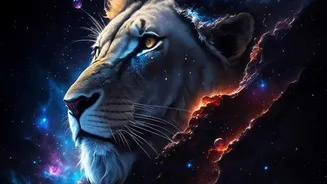
by a parka. However, this name has been discontinued due to its insensitive nature. More recently, some have nicknamed it the Lion Nebula because of its resemblance to a lion's face and mane. These features are shells of material ejected by the central star. The 'face' is an inner bubble of gas being pushed out by a strong wind of particles from the star, while the 'mane' or 'parka' is an outer disk filled with comet-shaped objects whose tails stream away from the star's intense radiation.
An Old Cosmic Puzzle
For astronomers, the beauty of NGC 2392 has always held a puzzle. The nebula has a complex, double-shell structure that suggests a tumultuous history. The inner bubble and the outer layers have different shapes and compositions, hinting at multiple stages of mass ejection from the dying star. Earlier observations, including those from the Hubble Space Telescope, revealed the intricate shapes but couldn't fully penetrate the layers of gas and dust to understand the processes driving them. Questions remained about why the nebula was so complex and what was happening deep inside the glowing clouds.
Webb's Infrared Vision
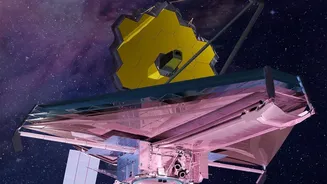
This is where the James Webb Space Telescope (JWST) changes the game. Webb observes the universe in infrared light, which can pass through clouds of gas and dust that obscure the view of telescopes like Hubble, which primarily see in visible light. Using its powerful NIRCam (Near-Infrared Camera) and MIRI (Mid-Infrared Instrument), Webb has peered into the heart of NGC 2392, mapping the distribution and temperature of its components in unprecedented detail. This new composite image gives scientists a clearer view of how the central star is sculpting its surroundings, distinguishing between hot, ionized gas and cooler, denser pockets of dust.
A Story Written in Dust
Webb's new map reveals a dramatic scene. At the center is the super-hot remnant of the original star, known as a white dwarf, blasting its surroundings with radiation. This energy is carving out the inner bubble of the nebula. The outer "mane" is composed of dense clumps of dust and gas. Webb's observations show that these clumps are durable enough to survive the stellar radiation, and they act like shields, protecting the material behind them. This interaction between the star's fierce output and the dense, clumpy material it previously ejected is what creates the nebula's complex, lion-like appearance. The map effectively gives astronomers a snapshot of a dynamic, violent process that is still unfolding.
A Glimpse of Our Sun's Fate
Studying planetary nebulae like NGC 2392 isn't just about admiring beautiful cosmic objects; it's also a way of looking into the distant future of our own solar system. Our Sun is a medium-mass star, and in about five billion years, it will also exhaust its fuel and shed its outer layers to form a planetary nebula. The detailed processes are still a subject of intense study, and every new observation from Webb provides crucial data. By understanding the intricate dance of gas, dust, and radiation in NGC 2392, we gain a clearer picture of the final, dramatic life stages of Sun-like stars across the universe. The nebula itself will continue to expand and is expected to dissipate into interstellar space in about 10,000 years, a fleeting moment on a cosmic timescale.