







What Was Supposed to Happen
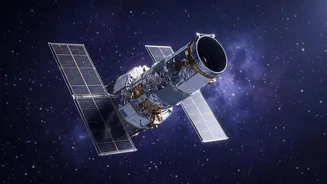
The plan was ambitious and a potential glimpse into the future of spaceflight: a commercial company would save a government satellite. NASA's Swift Observatory, launched in 2004, has been slowly falling from orbit. Its altitude has been decaying due to atmospheric
drag, a process accelerated by recent increases in solar activity that caused Earth's upper atmosphere to expand. To save the valuable telescope, NASA awarded a $30 million contract to a private company, Katalyst Space Technologies, to build a robotic servicing spacecraft called LINK. The LINK spacecraft launched on July 3, 2026, with the goal of chasing down Swift, grabbing it with robotic arms, and using its own thrusters to push the observatory into a higher, more stable orbit, extending its life for years.
A Mission Hits a Critical Failure
The headline-making problem occurred in late July. The LINK servicing spacecraft experienced critical issues with its attitude control system, specifically the failure of two of its three reaction wheels, which are essential for controlling a spacecraft's orientation. This malfunction sent the LINK spacecraft into an uncontrolled spin, making it impossible to safely approach and dock with Swift. Despite efforts by engineers to regain control, the ongoing issues proved insurmountable. On August 19, NASA and Katalyst officially announced that the primary goal of the mission—capturing and boosting Swift—would be abandoned.
The End of an Era for Swift
Without the orbital boost from LINK, the Swift Observatory is now doomed. NASA anticipates the 21-year-old telescope will re-enter Earth's atmosphere and burn up later this year. Originally designed for a two-year mission, Swift has been a workhorse for astronomers, providing invaluable data on gamma-ray bursts—the most powerful explosions in the universe. Over its two decades in space, its mission expanded, and it became a crucial tool for rapid-response astronomy, studying everything from supernovae to newly discovered black holes. Its loss will leave a gap in astronomers' ability to quickly react to sudden cosmic events.
A High-Risk, High-Reward Gamble
From the beginning, NASA acknowledged the mission was a long shot. The timeline was incredibly compressed, with Katalyst building and testing the LINK spacecraft in just nine months to meet the urgent deadline imposed by Swift's decaying orbit. In a statement, NASA officials framed the mission as a worthwhile risk. They emphasized that even in failure, the project pushed the boundaries of commercial satellite servicing and provided valuable lessons. The mission demonstrated the potential for public-private partnerships to tackle complex challenges in space, even if this particular attempt was not successful.
What Happens Next
While the rescue is off, the mission isn't entirely over. NASA and Katalyst still plan to have the LINK spacecraft attempt a rendezvous and perform proximity operations near Swift. This will allow them to test autonomous navigation systems and gather as much data as possible to inform future satellite servicing missions. These lessons could be vital for future efforts, including potential servicing missions for other aging assets in orbit, like the Hubble Space Telescope. For Swift, however, its watch is over. NASA will now rely on other current missions to help fill the observational void left by the loss of this venerable observatory.