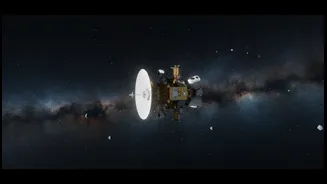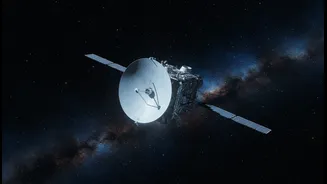







An Audacious Goal
The story of New Horizons is one of persistence, not just in space, but on Earth. For decades, a mission to Pluto, the last unexplored classical planet, was a top priority for scientists that remained stubbornly out of reach. Proposals were repeatedly
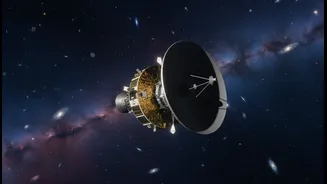
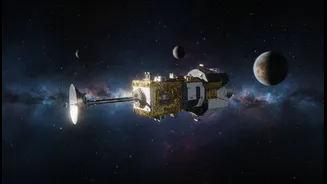
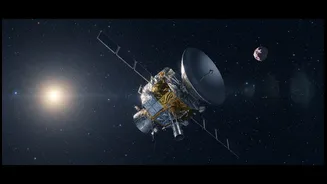
delayed or cancelled. But a dedicated team led by principal investigator Alan Stern championed the cause, finally securing approval for a mission that would have to be fast, light, and resilient. Launched in 2006, New Horizons was the fastest spacecraft ever to leave Earth, a necessity for its decade-long, three-billion-mile chase to catch Pluto. To save years of travel time, it performed a crucial gravity-assist maneuver around Jupiter in 2007, a move that also served as a dress rehearsal for its instruments.
Nine Years of Silence and a Historic Hello
For most of its journey to the outer solar system, New Horizons was a ghost. To conserve power and protect its systems, the spacecraft was placed in hibernation for long periods, waking only for brief annual check-ups. Its operators on Earth could only wait as it silently crossed the orbits of Saturn, Uranus, and Neptune. Finally, in 2015, it awoke for its grand purpose. The Pluto flyby was a moment of immense tension and discovery. For a few frantic hours, the probe executed a pre-programmed sequence, gathering as much data as possible. Because of the 4.5-hour one-way light delay, mission control could only wait for the signal confirming it had survived the encounter. When the message arrived, it heralded a new era in planetary science.
Rewriting the Textbooks on Pluto
Before New Horizons, Pluto was a faint, blurry dot in our most powerful telescopes. After, it became a vibrant, complex world. The probe revealed towering mountains of water ice, vast nitrogen glaciers like the iconic heart-shaped Sputnik Planitia, and a surprisingly complex, hazy blue atmosphere. We learned that Pluto was not an inert ball of ice but a geologically active dwarf planet. Its largest moon, Charon, was equally fascinating, with its own chasms and a mysterious reddish polar cap. The data, which took over 15 months to fully download due to the slow transmission speeds over such a vast distance, completely transformed our understanding of the solar system's distant third zone.
An Encore in the Kuiper Belt
Pluto was just the beginning. The mission team had another audacious goal: to visit an even more distant object in the Kuiper Belt, the vast ring of icy bodies beyond Neptune. Using the Hubble Space Telescope, they found a suitable target, a small object later named Arrokoth. On New Year's Day 2019, New Horizons flew past it, setting a new record for the most distant object ever explored by a spacecraft. The images revealed a strange, reddish, double-lobed object that looked like a flattened snowman. Arrokoth is a contact binary, two ancient bodies that gently merged billions of years ago. As a pristine relic from the dawn of the solar system, it offered unparalleled clues into how planets are formed.
The Secrets of a Deep-Space Survivor
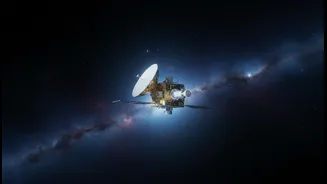
New Horizons’ survival is a feat of engineering. Too far from the sun for solar panels, it relies on a Radioisotope Thermoelectric Generator (RTG), which uses the heat from decaying plutonium to generate a small but steady supply of electricity. This power source, combined with clever resource management and long hibernation cycles, has kept it alive. The spacecraft has just recently, in mid-2026, awakened from its longest hibernation yet—a 321-day slumber—at a distance of nearly six billion miles. Its systems are reported to be in perfect health, a remarkable achievement given the extreme cold and radiation of deep space. It now continues its work as a unique observatory, studying the heliosphere and other Kuiper Belt objects from a vantage point no other active mission has.