





The Celestial Battle of Gods and Demons
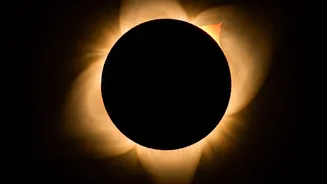
The core belief behind the inauspicious nature of a Grahan is rooted in Hindu mythology, specifically the tale of the Samudra Manthan, or the churning of the cosmic ocean. According to the Puranas, when the nectar of immortality (Amrita) emerged, an asura
(demon) named Svarbhanu disguised himself as a deva (god) to drink it. The Sun (Surya) and Moon (Chandra) deities spotted the deception and alerted Lord Vishnu. Vishnu swiftly decapitated the demon with his Sudarshana Chakra, but not before a drop of nectar had been consumed, granting the demon immortality. His severed head became known as Rahu and his body as Ketu. In eternal vengeance against the Sun and Moon for exposing him, Rahu periodically chases and swallows them, causing an eclipse. Because Rahu has no body, the Sun or Moon eventually emerges, but this temporary overpowering of light by darkness is considered a deeply inauspicious event.
A Time of Disturbed Energy
From a spiritual and astrological viewpoint, a Grahan is a time when the natural order is disrupted. The Sun is considered the source of 'prana' or life-force energy, and its obscuration is believed to contaminate the atmosphere with negative or unstable energies. This is why eclipses are traditionally seen as a bad omen, unsuitable for auspicious activities like weddings, starting a new business, or even regular worship. Hindu scriptures and astrological texts, or Dharma Shastras, advise that the environment becomes spiritually polluted during this time, and it's best to avoid activities that could attract this negativity. Even food and water are considered susceptible to contamination from these disturbed energies. This belief is so pervasive that many temples close their doors during the eclipse to protect the sanctity of the idols and the sacred space.
Observing the Sutak Period
The time of caution begins even before the eclipse starts, with a period known as 'Sutak'. For a solar eclipse (Surya Grahan), Sutak traditionally begins 12 hours prior, and for a lunar eclipse (Chandra Grahan), it starts 9 hours before. During Sutak, a set of rules is observed to minimise exposure to the inauspicious energies. The primary prohibitions include cooking, eating, and drinking. Many households prepare for this by finishing their meals before Sutak starts and fasting throughout the duration of the eclipse. To protect cooked food and stored water from being contaminated, leaves of Tulsi (holy basil) are often placed in them, as Tulsi is believed to have purifying properties. Exemptions are typically made for the very young, the elderly, and the sick, for whom restrictions are less stringent.
Turning Inward for Reflection
The restrictions on external activities serve a deeper purpose: to turn one's focus inward. With daily routines like cooking and eating paused, the Grahan period becomes a powerful time for spiritual practices (Sadhana). Instead of being a time of fear, ancient traditions view it as a potent window for meditation, prayer, and mantra chanting (japa). It is widely believed that the spiritual benefits of such practices are multiplied manyfold during an eclipse. Chanting specific mantras like the Gayatri Mantra or Mahamrityunjaya Mantra is highly recommended to ward off negative influences and generate positive vibrations. This is the essence of why a Grahan is for reflection, not spectacle. By withdrawing from the material world, one is encouraged to engage in inner cleansing and connect with the divine.
Purification After the Shadow Passes
Once the eclipse is over, a series of purification rituals are performed. The most important of these is taking a ritual bath (snana) to cleanse oneself of any residual negative energy from the Grahan period. People often sprinkle their homes with holy water, such as Ganga Jal, and change into fresh clothes. Following the bath and cleansing, it is also a common practice to give charity (daan), as acts of giving after the eclipse are believed to mitigate any negative effects and earn significant spiritual merit. Temples reopen their doors, often after performing their own purification rituals, and normal life resumes. These practices underscore the idea of the eclipse as a complete cycle: a period of impurity and withdrawal, followed by a deliberate and comprehensive purification.