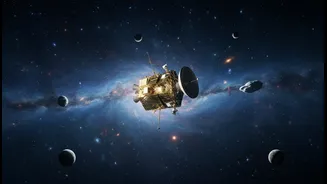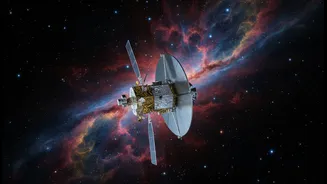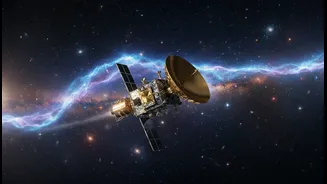









A Wake-Up Call from Deep Space
In late June 2026, after a 321-day hibernation to conserve energy, the New Horizons spacecraft successfully powered back up its systems. Mission controllers at the Johns Hopkins Applied Physics Laboratory confirmed the probe was in good health, a message
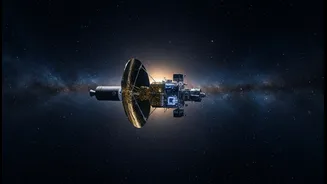
that took nearly nine hours to travel across the vastness of space. Launched in 2006, New Horizons is now so far from home that it’s over 64 times farther from the Sun than Earth is. This wake-up isn't in preparation for visiting another world, but for a new phase of its mission: to serve as humanity's lonely sentinel in the dark, cold expanse of the outer solar system.
From Pluto's Heart to the Kuiper Belt
New Horizons etched its place in history on July 14, 2015, when it flew past Pluto, transforming the dwarf planet from a fuzzy pixel into a complex world with soaring ice mountains, vast nitrogen glaciers, and a surprisingly blue atmosphere. It sent back images that revealed a giant, heart-shaped feature on Pluto's surface, capturing the public's imagination. But its work wasn't done. On New Year's Day 2019, the probe made history again by visiting Arrokoth, a snowman-shaped object in the Kuiper Belt. This encounter remains the most distant flyby ever conducted, giving scientists an unprecedented look at one of the primitive building blocks of our solar system.
What Is the 'Edge' of the Solar System?
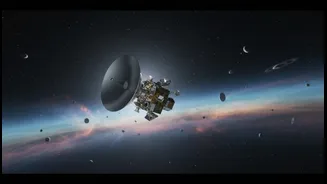
The probe is now journeying through the Kuiper Belt, a doughnut-shaped ring of icy bodies beyond Neptune's orbit. Its ultimate destination is the heliopause, the theoretical boundary where the Sun's influence ends. This is the true edge of our solar system. Think of the Sun as spewing out a constant stream of charged particles called the solar wind, which carves out a protective bubble in space called the heliosphere. The heliopause is the edge of this bubble, where the solar wind's outward push is finally balanced by the pressure of the interstellar medium—the gas and dust that drifts between the stars. Only two other spacecraft, Voyager 1 and Voyager 2, have ever crossed this boundary into interstellar space.
A New Mission as a Deep-Space Observatory
With no more flyby targets in its path, New Horizons has been repurposed as a deep-space observatory. While it was hibernating, its instruments continued to collect data on the charged particles and dust in its environment. Now that it's awake, it will begin sending that information back to Earth and start new observations, including a study of hydrogen at the far reaches of the heliosphere. This data is invaluable because it helps scientists understand the structure of our solar system's protective bubble and the nature of the space that lies beyond it. The probe is effectively a weather station in a region no other active mission is exploring.
A Fading Pioneer on a Long Goodbye
New Horizons is powered by a Radioisotope Thermoelectric Generator (RTG), which converts heat from the decay of plutonium into electricity. This nuclear battery has allowed the probe to operate for two decades, but its power is finite and slowly decreasing. At launch, it provided about 245 watts of power, which had fallen to around 200 watts by the time it reached Pluto. Scientists expect the probe could continue to send back data into the 2040s or even 2050s, though its capabilities will diminish as the power dwindles. Each bit of data it returns is a precious postcard from the frontier, a final gift from one of humanity's great exploratory missions.