

Our Cosmic Next-Door Neighbor
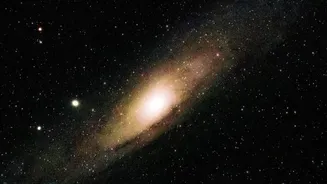
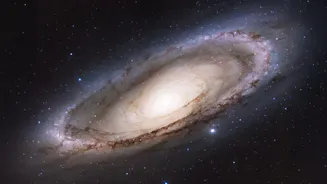
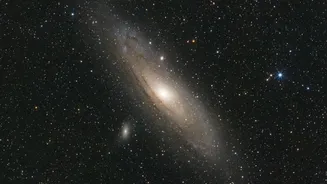
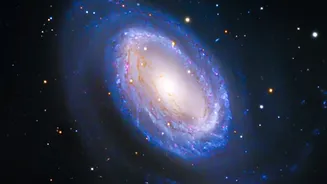
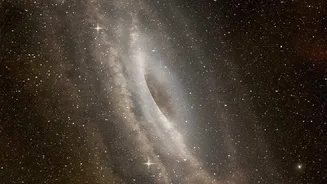
At 2.5 million light-years away, the Andromeda galaxy (M31) is our closest major galactic neighbor. It's so close that it's visible to the naked eye in dark skies and serves as an ideal laboratory for understanding how large spiral galaxies like our own
Milky Way form and evolve. Because we are inside the Milky Way, we can't get a clear, outside view of its overall structure. Andromeda, however, offers a complete panorama, allowing astronomers to study a whole galaxy in immense detail. This unique vantage point is critical for piecing together the life story of galaxies, from their most active periods of star birth to their eventual, quieter retirements.
A Deep Dive with Hubble
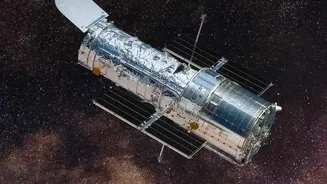
To unravel Andromeda’s history, astronomers have turned to the unparalleled vision of the Hubble Space Telescope. A recent study combines data from two massive surveys: the Panchromatic Hubble Andromeda Treasury (PHAT) and its southern counterpart, PHAST. Together, these programs mapped about two-thirds of Andromeda's sprawling disk, resolving an incredible 200 million individual stars. This allows scientists to create a 'fossil record' of the galaxy. By analyzing the colors and brightness of these stars—young, massive stars burn hot and blue, while older, smaller stars glow red and live longer—researchers can determine when and where star formation has occurred throughout Andromeda’s history.
A Tale of Two Eras
The data paints a picture of a galaxy with a dramatic past. About two billion years ago, Andromeda experienced a massive burst of star formation, likely triggered by a merger or interaction with another, smaller galaxy. This event produced a significant portion of all the stars in the galaxy. However, a new analysis published in The Astrophysical Journal in July 2026 reveals what happened next. For the last 500 million years, star formation has been steadily declining. Five hundred million years ago, Andromeda was creating stars at a rate of about one solar mass per year, similar to the Milky Way's current rate. But that has slowed dramatically. By 40 million years ago, the rate had halved, and today it has plummeted to just one-fifth of a solar mass per year.
The Cosmic Slowdown
So why the decline? The study found the slowdown isn't happening uniformly. Much of the recent star-making activity has been concentrated in a vast ring of gas and dust about 32,000 light-years from the galaxy's center. It is the fading activity within this specific ring that is driving the galaxy's overall decline. Scientists believe this isn't because the galaxy is running out of the raw material for stars, but rather that it's in a natural winding-down period after its earlier, more energetic burst. Lead author Tobin Wainer of the University of Washington likens it to taking a breather after running a marathon.
A Likely Suspect
While the overall decline seems to be a natural process, there is a hint of outside influence in a specific region. The small satellite galaxy M32 is a close companion to Andromeda, and some theories suggest it may have collided with Andromeda's disk in the past. The new data shows that the area of Andromeda closest to M32 experienced a drop in its star-formation rate beginning about 60 million years ago, a pattern not seen elsewhere. While this timing doesn't perfectly align with current models of M32's path, the proximity makes it a prime suspect for this localized slowdown. As Wainer noted, while they can't definitively blame M32, it's "definitely the most likely suspect."