







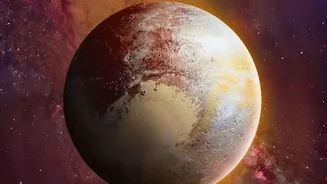
A Planetary Time Capsule
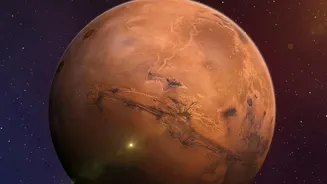
Mars has long captivated our imagination, with tantalising signs that it once hosted rivers, lakes, and perhaps a thicker atmosphere. Scientists have pieced together this history by studying its geology, but a key question remains: what happened to that early,
more hospitable climate? The answer, it seems, may be written in the planet's rocks, specifically in how common minerals changed in the presence of water billions of years ago. Recent studies suggest these microscopic transformations can act as tiny time capsules, preserving a detailed record of the environmental conditions at the very moment they formed.
From Olivine to Carbonate
One of the key minerals in this story is olivine, a greenish mineral common in volcanic rocks on both Earth and Mars. Olivine is known to break down relatively quickly when it comes into contact with water. When water and carbon dioxide are present, olivine can be altered into carbonate minerals. For years, scientists were puzzled by the apparent lack of large carbonate deposits on Mars, which seemed to contradict the evidence for a past CO2-rich atmosphere and abundant water. However, recent discoveries by rovers like Perseverance and Curiosity have confirmed the presence of these carbonates, suggesting that this chemical transformation was indeed a key process in the planet's history. The process essentially locked atmospheric carbon dioxide into the Martian crust.
Decoding the Mineral Record
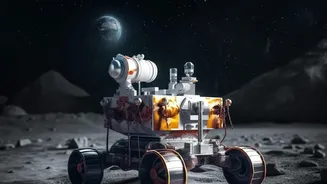
The latest research focuses not just on the presence of these minerals, but on their physical characteristics. In a new study analyzing data from the Curiosity rover, scientists examined hematite, a form of iron oxide, or rust. They found that the size of the hematite crystals can reveal how warm the water was and how long it persisted. Larger crystals suggest that warm groundwater continued to move through rock layers for millions of years, even after surface lakes may have vanished. This process, known as Ostwald ripening, where smaller crystals dissolve and contribute to the growth of larger ones, points to a long, gradual drying process rather than a sudden climate collapse. It provides a physical timeline etched into the rock itself, showing that pockets of water likely existed underground long after the surface became the barren landscape we know today.
A New Chapter in Martian History
This microscopic evidence is rewriting our understanding of how Mars became uninhabitable. The transformation of minerals like olivine into carbonates and the growth of crystals like hematite provide a direct link to the planet's ancient atmosphere and water systems. The analysis of isotopes—different versions of elements like carbon and oxygen—within these minerals also points to extreme evaporation in the planet's past. These findings, gathered by rovers on the ground, offer a much more detailed picture than orbital scans can provide, revealing a complex and prolonged transition from a wet world to a dry one. It suggests Mars’s habitability didn't just switch off; it slowly faded, with water retreating underground where it may have persisted for eons.
Implications for the Search for Life
Beyond understanding climate change, this research has profound implications for the search for extraterrestrial life. Environments with persistent water, even if underground, are prime locations to look for signs of past microbial life, or biosignatures. The same mineral alteration processes that recorded the climate could have also created and preserved microscopic niches where life might have thrived. The tiny pores and structures within these altered minerals could have sheltered organic molecules from Mars's harsh surface radiation. As rovers continue to analyse these ancient rocks, they are not just reading a climate history; they are also searching for the faintest whispers of a time when the Red Planet may have been a living one.