




The Junkyard Above Our Heads
For decades, the space above Earth has been treated as an infinite resource. Every rocket launch and satellite deployment has left something behind, from spent rocket stages to defunct satellites and fragments from accidental collisions. Today, low Earth orbit
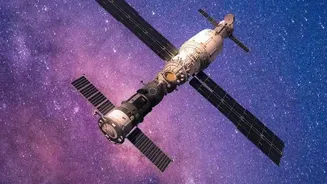
(LEO) is a congested highway. There are over 36,000 tracked objects larger than 10 centimetres, but millions of smaller, untrackable pieces also zip around at speeds exceeding 7 kilometres per second. At these velocities, even a small fragment can cripple an operational satellite. The total mass of this orbital debris is estimated to be over 13,000 tonnes. The growing risk is what experts call the Kessler Syndrome: a chain reaction where collisions create more debris, leading to more collisions, potentially rendering entire orbits unusable.
Deconstructing the Tonne-Per-Week Stat
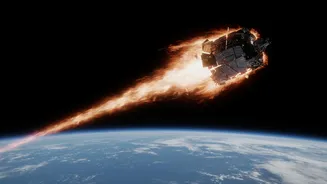
The figure of a one-tonne object re-entering Earth's atmosphere each week is a stark illustration of the problem's scale. This isn't one giant object, but an average. It includes large, defunct hardware like rocket bodies and old satellites that are finally succumbing to atmospheric drag. While most smaller pieces burn up completely, heavier and more heat-resistant components like titanium fuel tanks and steel engine parts can and do survive the fiery descent. Recent incidents, such as a large rocket ring crashing onto farmland in Kenya, demonstrate that these are not just theoretical risks. According to the Polish Space Agency, re-entries happen daily, but objects weighing a tonne or more come down about once a week. The US Space Force has also noted a dramatic increase in reentry alerts, from 110 a decade ago to nearly 820 in the last year, reflecting the surge in launch activity.
The Cosmic Cleanup Crew: Methods and Tech
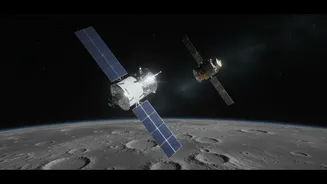
The monumental challenge of cleaning up space has given rise to a new market: Active Debris Removal (ADR). This isn't about sending someone up with a bin bag; it's a field of advanced robotics and astrophysics. Several methods are being developed and tested. Companies like Astroscale and ClearSpace are pioneering missions to rendezvous with, capture, and de-orbit large pieces of junk. Technologies being demonstrated include giant nets to bag debris, powerful harpoons to spear and control targets, and sophisticated robotic arms for a gentler grab. Other futuristic concepts include ground-based lasers to gently nudge debris off a collision course or into a decaying orbit, and electrodynamic tethers that use Earth's magnetic field to slow objects down.
From Public Mission to Private Enterprise
For years, space agencies like NASA and the European Space Agency (ESA) have led research into the debris problem. Now, a vibrant commercial market is emerging. The space debris removal market was valued at USD 0.1 billion in 2023 and is projected to grow to USD 0.6 billion by 2028, showing explosive potential. Startups and established aerospace giants are entering the field, including Astroscale (Japan), ClearSpace (Switzerland), and Northrop Grumman (US). Some, like Portal Space Systems and Paladin Space, are partnering to create 'Debris Removal as a Service' (DRAAS), aiming to make cleanup a routine, operational part of space logistics rather than a one-off experiment. This shift reflects a broader understanding that a sustainable space economy requires active environmental management.
The High Cost of a Cleaner Orbit
Despite the technological progress, significant hurdles remain. The first is cost. Developing and launching a single debris removal mission can cost hundreds of millions of dollars. The second is legal and political. Who is responsible for old debris? Who has the right to remove an object owned by another country, even if it's defunct? These questions of ownership and liability are complex and largely unresolved. Finally, the technical challenge is immense. Capturing a tumbling, non-cooperative object moving at thousands of kilometres per hour is one of the most difficult robotic manoeuvres ever attempted. Yet the cost of inaction is seen as far greater, with vital infrastructure for communications, navigation, and climate monitoring at risk.