




The World's Maritime Superhighways
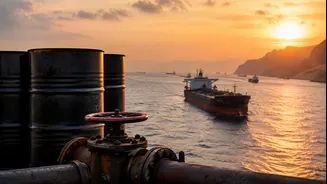
The Strait of Hormuz is a narrow waterway linking the Persian Gulf to the Arabian Sea, acting as the main sea route for oil from the Middle East. The Bab el-Mandeb strait connects the Red Sea to the Gulf of Aden and the Indian Ocean, forming the southern
gateway to the Suez Canal. Together, they are two of the most critical chokepoints in the world for maritime trade. Any instability affecting these passages has consequences that extend far beyond the immediate region, disrupting global supply chains and creating economic uncertainty.
A River of Oil and Goods
The sheer volume of trade passing through these straits is staggering. The Strait of Hormuz alone accounts for about 20% of the world's total oil consumption and a significant portion of global Liquefied Natural Gas (LNG) trade. For India, the dependency is acute. Around 40-50% of the nation's crude oil imports, 50% of its LNG, and a staggering 90% of its Liquefied Petroleum Gas (LPG) imports travel through Hormuz. The Bab el-Mandeb is crucial for broader trade, forming part of the route that carries an estimated 10-12% of all global seaborne commerce, linking Asia with Europe. A simultaneous disruption could jeopardize up to 25% of the world's oil and gas supply and 30% of global container shipping.
The Immediate Impact: At the Petrol Pump
For the average Indian household, the most immediate and noticeable impact of a crisis in these straits would be at the petrol pump. Since India imports over 80% of its crude oil, any disruption to supply or even the perception of a future disruption causes global oil prices to surge. This directly translates into a higher import bill for the country. As seen in past crises, a spike in crude prices could lead to an increase in retail prices for petrol and diesel, affecting everything from the daily commute to the cost of public transportation.
The Ripple Effect: Groceries, Gas, and Goods
The impact doesn't stop with fuel. Higher diesel costs increase transportation expenses for virtually all goods, contributing to food inflation and rising prices for everyday items. Furthermore, India's heavy reliance on LPG imports from the Gulf means that a Hormuz closure could directly threaten the supply of cooking gas to over 330 million households. The crisis would also hit industries hard. Fertilizers, crucial for agriculture, are heavily imported through these routes. Petrochemicals, which form the building blocks for plastics, packaging, and countless consumer goods, would also face supply chain chaos. The result is widespread inflation that erodes household purchasing power.
How Businesses Would Navigate the Crisis
For Indian businesses, a chokepoint crisis presents a multi-front challenge. Shipping lines would be forced to reroute vessels around the Cape of Good Hope, a journey that can add over 10 days and thousands of kilometres to a voyage. This leads to a cascade of costs: higher fuel consumption, increased freight charges, and skyrocketing insurance premiums. War-risk insurance premiums for vessels have been known to spike by as much as 1,000% during periods of high tension. Companies would face delivery delays for essential raw materials and components, disrupting production schedules. The increased costs and uncertainty would likely put pressure on the profit margins of businesses, particularly impacting import-dependent sectors and small and medium-sized enterprises (MSMEs).