


The Violent Death of a Star
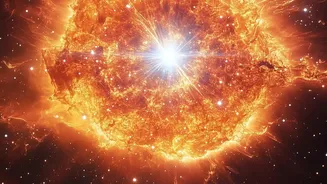
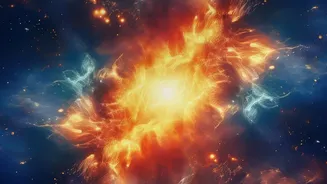
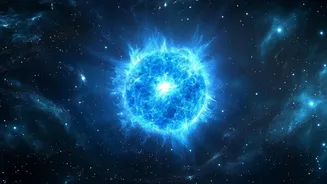
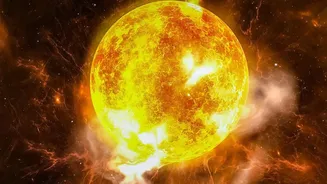
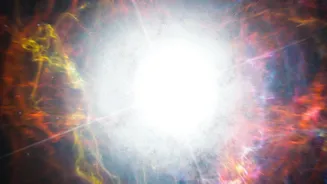
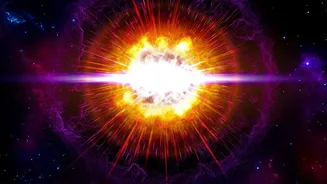
For most massive stars, those many times heavier than our Sun, life ends in a dramatic and violent explosion known as a supernova. After exhausting their nuclear fuel, the star's core can no longer support its own immense weight and collapses catastrophically.
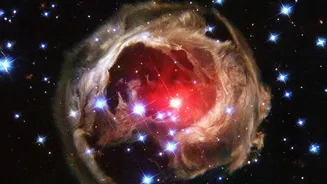
This implosion triggers a powerful shockwave that blasts the star's outer layers into space, creating a breathtaking cosmic spectacle that can outshine an entire galaxy for weeks. What’s left behind is usually an ultra-dense object called a neutron star. For decades, this was considered the standard script for the end of a massive star's life, a celestial firework show that seeds the universe with heavy elements essential for forming new stars, planets, and even life.
A Cosmic Disappearing Act
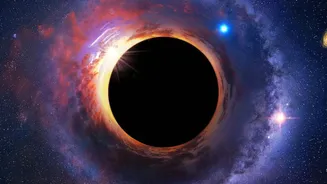
But astronomers have been puzzled by a strange phenomenon: some massive stars seem to skip the supernova phase entirely. Instead of exploding, they appear to simply fizzle out and disappear from view. This process, known as a 'failed supernova' or 'direct collapse', has long been theorized but difficult to observe. In these cases, the star's core collapses with such overwhelming gravitational force that not even a powerful shockwave can escape. The star implodes so completely that it forms a black hole directly, swallowing itself from the inside out without the brilliant flash of a supernova. These quiet deaths could explain why astronomers observe fewer supernovae from the most massive stars than expected.
Enter the Ghost Particle
The prime suspect in explaining this stellar disappearing act is the neutrino. Often called 'ghost particles', neutrinos are fundamental particles with almost no mass and no electric charge. They interact so weakly with other matter that trillions of them pass through your body every second without you ever noticing. During a star's core collapse, an unimaginable number of neutrinos are created, carrying away about 99% of the event's total energy. In a successful supernova, these neutrinos deposit enough energy into the surrounding stellar material to help power the explosive rebound. But if something changes in how these neutrinos behave, the outcome can be very different.
A Telltale Neutrino Signature
Recent research suggests that the key lies in the ability of neutrinos to change 'flavour'. Neutrinos come in three types—electron, muon, and tau—and can oscillate between them. According to new models, if neutrinos change flavour in a specific way during the core collapse, they might fail to provide the necessary heating to trigger an explosion. This flavour-switching can create a hotter, denser core that is more prone to collapsing directly into a black hole. Such an event would produce a unique signal: a short, intense burst of high-energy neutrinos, but very little visible light. While a supernova neutrino burst might last for around 10 seconds, the signal from a failed supernova would be much shorter, perhaps only a second long. This distinct signature is what scientists are now hunting for.
The Hunt for Cosmic Clues
Detecting these specific neutrino bursts is a monumental challenge. Giant underground observatories like Super-Kamiokande in Japan and IceCube at the South Pole are designed to catch these ghostly messengers. So far, the only supernova neutrinos ever detected came from a nearby explosion in 1987, and there were only a handful of them. But scientists are hopeful. Confirming a neutrino signal from a failed supernova would provide direct evidence of this quieter pathway to black hole formation. It would solve the long-standing mystery of the 'missing' supernovae and give us a more complete picture of how the most massive objects in the universe live and die. By listening for these ghostly whispers, astronomers hope to finally witness the silent birth of a black hole.