


A Granular Look at Our Star
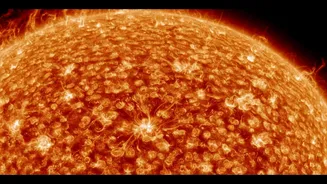
The latest, highest-resolution images of the sun are astonishing. They reveal a landscape of boiling plasma, sectioned into cell-like structures known as granules. Many of these churning cells are as large as France or Texas, with hot plasma rising in their
bright centers and cooling as it sinks back down in the dark, narrow lanes between them. For the first time, images captured in 2026 have shown ultra-fine details, including swirls and thread-like “striations” at the edges of these granules. These patterns are the first direct proof of a long-predicted phenomenon called the Kelvin-Helmholtz instability, which occurs when fluids or plasmas moving at different speeds slide past each other, creating wave-like vortices. Being able to see features as small as a city allows scientists to move beyond theory and directly observe the fundamental physics driving our star.
The Technology Behind the Clarity
Capturing such sharp images from Earth is a monumental technological challenge. Our planet's turbulent atmosphere blurs and distorts light, which is why stars twinkle. To overcome this, the world's most powerful solar telescopes use a groundbreaking technology called adaptive optics (AO). An AO system uses a deformable mirror that can change its shape hundreds or even thousands of times per second. A sensor measures the atmospheric distortion in real-time, and the mirror rapidly adjusts to counteract the blur, resulting in images that are almost as clear as if they were taken from space. This technology, combined with very large primary mirrors that collect more light, is the key to achieving diffraction-limited resolution, the theoretical maximum sharpness a telescope can provide.
Titans of Solar Observation
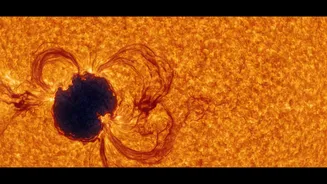
While NASA operates many vital space-based solar missions, the quest for the sharpest visible-light images has been led by ground-based observatories. For over a decade, the 1.6-meter Goode Solar Telescope (GST) at Big Bear Solar Observatory in California, operated by the New Jersey Institute of Technology, was the highest-resolution solar telescope on the planet. It has been responsible for numerous breakthroughs in our understanding of sunspots and magnetic fields. More recently, the National Science Foundation's Daniel K. Inouye Solar Telescope (DKIST) in Hawaii has taken the lead. With a massive 4-meter primary mirror, it is currently the world's most powerful solar telescope, capable of resolving structures on the sun just a few dozen kilometers across. It was the Inouye telescope that provided the first-ever images of the Kelvin-Helmholtz instability on the solar surface in 2026.
More Than Just a Pretty Picture
This unprecedented level of detail is about more than just capturing stunning visuals. It provides crucial data for understanding and predicting space weather. The sun’s magnetic fields are responsible for dramatic events like solar flares and coronal mass ejections (CMEs), which can send streams of charged particles hurtling towards Earth. These solar storms can disrupt power grids, damage satellites, and interfere with GPS and communications systems. By studying the fine-scale magnetic structures and plasma flows on the surface, scientists can build more accurate models of what drives these powerful eruptions. The recent discovery of instabilities at a small scale, for instance, could be a missing piece of the puzzle in explaining why the sun's outer atmosphere, the corona, is hundreds of times hotter than its surface.