

Why Halving Isn't Simple Math
You found the perfect recipe, but it serves six. You dutifully cut every ingredient in half, only to end up with a dish that’s oddly textured, bland, or just plain wrong. What happened? The problem is that cooking isn't always a linear equation. While
bulk items like flour or meat often scale predictably, other ingredients have more complex roles. Leavening agents like baking soda and yeast, for example, rely on chemical reactions that require specific ratios. Halving them can sometimes lead to dense, flat baked goods. Spices and salt are another culprit. Their flavor can concentrate differently in smaller volumes, meaning half the recipe might not need exactly half the salt. And then there's the dreaded 'half an egg.' While you can whisk an egg and use half (about two tablespoons), it's a common stumbling block that shows how recipes aren't designed with solo cooks in mind.
The Pan Size Problem
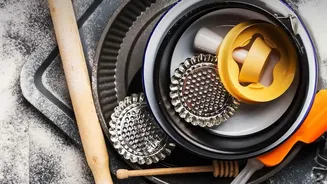
One of the most overlooked aspects of scaling down is cookware. Using the same large skillet or baking dish for a half-batch of food can spell disaster. A smaller amount of food spread across a large surface area will cook much faster, increasing the risk of it drying out or burning. In a too-large pan, sauces reduce too quickly, and the moisture can evaporate before vegetables have a chance to cook through. The key is to match the pan to the portion size, aiming to keep the depth of the food consistent with the original recipe's intention. For instance, if a full recipe for a 9x13-inch pan is halved, it will likely fit well in an 8x8-inch or 9-inch round pan, which have roughly half the surface area.
Rethinking Your Cooking Time
It seems logical that half the food would take half the time to cook, but this is rarely the case. Cooking time is more dependent on the thickness and density of the food than the total volume. A smaller batch will almost always cook faster than the original recipe suggests, but the reduction isn't a simple 50%. A good rule of thumb is to start checking for doneness about 25% earlier than the original time. For baked goods, this might mean setting a timer for half the original time just to be safe, then checking frequently until it's done. Remember, you can always cook something for longer, but you can't un-burn it. An instant-read thermometer is your best friend here, taking the guesswork out of determining if your smaller portion is cooked through.
Smart Strategies for Solo Cooking
Instead of constantly wrestling with complex recipe conversions, you can adopt a few strategies to make your life easier. First, consider making the full recipe and freezing the rest in individual portions. Soups, stews, and casseroles are perfect for this approach. Second, build a collection of recipes specifically designed for one or two servings. Many websites and cookbooks now cater to this exact need. Finally, investing in smaller cookware—like a small skillet, a toaster oven-sized baking sheet, or a mini loaf pan—can make a world of difference. It ensures your smaller portions cook evenly and as intended.
Embrace 'Non-Recipe' Cooking
Perhaps the best approach for the solo cook is to move away from rigid, multi-serving recipes altogether. Embrace component cooking and flexible meal formats that are easy to scale up or down by nature. Think grain bowls, loaded salads, stir-fries, frittatas, and omelets. You can prep individual components—like a batch of quinoa, roasted vegetables, or a versatile sauce—at the beginning of the week. Then, each day, you can assemble a fresh, satisfying meal for one without worrying about precise measurements or tricky conversions. This method not only simplifies cooking but also reduces food waste and encourages creativity in the kitchen.