



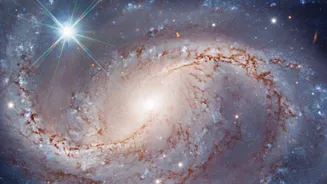
Our Neighbor Enters Retirement
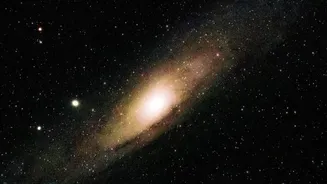
The Andromeda galaxy, our closest major galactic neighbor, is winding down. A recent, comprehensive study using years of data from the Hubble Space Telescope has revealed that Andromeda's era of prolific star birth is coming to a close. Astronomers found
that after a massive burst of activity about 2 billion years ago, the galaxy has been in a steady decline for the last 500 million years. This slowdown has become particularly sharp in the last 40 million years. To put it in perspective, 500 million years ago, Andromeda was creating stars equivalent to the mass of our sun every year. Today, that rate has plummeted to about one-fifth of that, signaling a major shift in its lifecycle.
A Tale of Two Galaxies
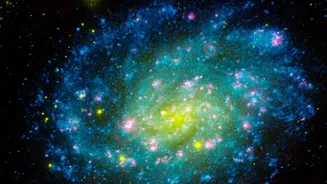
To understand what this slowdown means, it helps to look at another neighbor in our Local Group: the Triangulum galaxy. Also known as M33, Triangulum is the third-largest galaxy in our local cluster, after Andromeda and our own Milky Way. While smaller than Andromeda, it is a hive of activity. Studies show that Triangulum is a veritable 'hotbed of starbirth', forming new stars at a rate that is roughly ten times higher than what is currently observed in Andromeda. Its spiral arms are dotted with bright blue regions, signposts of rapid and recent star formation. This stark contrast between the two galaxies provides a perfect case study in galactic evolution, showing that not all cosmic neighbors follow the same life path.
Reading the Galactic Fossil Record
How can astronomers tell a galaxy is slowing down? They do it by conducting a cosmic census. The recent studies of Andromeda relied on Hubble's unparalleled ability to resolve hundreds of millions of individual stars within the galaxy's disk. Each star acts as a tiny fossil, telling a story about when it was born. Massive, hot stars burn bright blue but have very short lives, so their presence indicates recent star formation. Smaller, cooler, and redder stars live for much longer, representing the galaxy’s older populations. By analyzing the color and age of stars across thousands of different regions of Andromeda, researchers could piece together a detailed history of its star-forming activity over millions of years. This meticulous work allowed them to build a timeline and confirm that the galaxy is indeed entering a quieter, more quiescent phase.
Why Do Galaxies Stop Making Stars?
The process of a galaxy shutting down its star factory is known as 'quenching'. There are several reasons this can happen. A galaxy might simply exhaust its reserves of cold gas, the essential raw material needed to form new stars. Alternatively, internal processes like feedback from a supermassive black hole at the galaxy's center can heat up or expel this gas, preventing it from collapsing into stars. In Andromeda's case, astronomers have a prime suspect for its recent slowdown: a close encounter with its small satellite galaxy, M32. Evidence suggests that the gravitational disruption from M32's passage may have disturbed Andromeda’s gas reservoirs, contributing to the significant drop in star formation, especially in the region closest to the interaction.