





The Challenge of Lunar Navigation
For decades, navigating in space has been a complex process managed from Earth. Missions rely on the Deep Space Network, a collection of giant radio antennas, to track spacecraft. This system is reliable but cumbersome, requiring direct line-of-sight
and pre-scheduled communication windows. As humanity plans a sustained return to the Moon with the Artemis program, this approach is no longer sufficient. Astronauts exploring the hazardous lunar South Pole or robotic rovers venturing into permanently shadowed craters can't afford to lose contact or their sense of direction. Even using GPS signals from Earth, which was recently proven possible, is a limited solution and not a permanent fix.
Introducing LunaNet: An Internet for the Moon
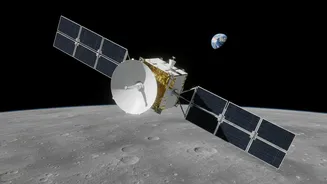
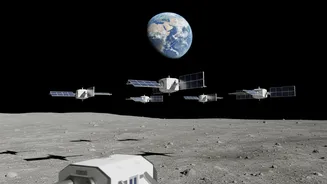
NASA's answer is LunaNet, an ambitious architecture designed to be a flexible and extensible communications and navigation network for the Moon. Think of it less as a single system and more as a framework, similar to the internet on Earth. The idea is to create an infrastructure that NASA, commercial companies, and international partners can all contribute to and use. This network will consist of satellites orbiting the Moon and potentially surface assets, all working together. The project responsible for enabling this is called the Lunar Communications Relay and Navigation Systems (LCRNS), which partners with commercial industry to build out this critical infrastructure.
How It Creates a Lunar GPS
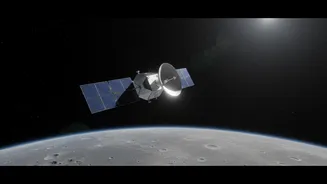
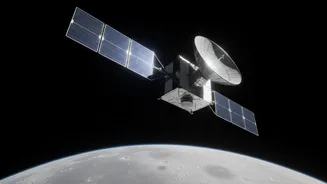
The core of LunaNet's capability comes from creating a constellation of satellites in lunar orbit. Much like GPS satellites orbit Earth, these lunar relays will provide Position, Navigation, and Timing (PNT) services to anyone on or around the Moon with a compatible receiver. This will allow for autonomous, real-time navigation without constant input from Mission Control on Earth. A key piece of technology, called NavCube3-mini, was recently delivered for integration into the first commercial lunar relay satellite. This device can use signals from Earth's existing GPS and Galileo systems to help establish its position, serving as a bridge until the full lunar-based network is operational.
What This New Infrastructure Unlocks
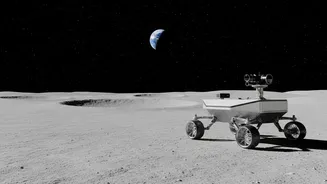
The applications are transformative. With reliable navigation, astronauts can explore farther and more safely. Robotic rovers can operate autonomously with greater precision, mapping resources or conducting science in hard-to-reach areas. Landing spacecraft will become far more accurate, allowing missions to target specific scientifically interesting sites or previously deployed assets. This network will also serve as a communications backbone, relaying data from the far side of the Moon, which is always hidden from Earth, and providing a constant link for missions even in the treacherous terrain of the lunar poles. This opens the door for building permanent habitats, mining operations, and large-scale science experiments.
A Collaborative and Commercial Future
Crucially, NASA is not building this system alone. The agency has designed LunaNet to be interoperable, meaning services and hardware from different countries and companies can work together seamlessly. The European Space Agency's Moonlight initiative and Japan's Lunar Navigation Satellite System are being developed to align with LunaNet standards. By procuring services from commercial partners like Intuitive Machines, NASA is fostering a new lunar economy. This approach reduces costs and accelerates development, creating opportunities for a host of new commercial activities on and around the Moon, much like the creation of GPS spawned countless industries on Earth.