









The Spark That Ignited the Debate
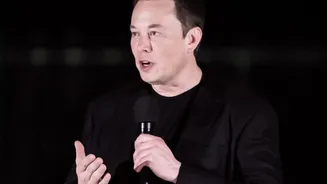
The controversy began with a simple, yet audacious, suggestion from Elon Musk. He proposed that users of his AI chatbot, Grok, could just take a picture of their credit card and upload it to let the bot find the best deals and place orders. This idea
was meant to showcase a future of seamless, AI-driven commerce. However, it immediately triggered a backlash from cybersecurity experts and the public. Critics were quick to point out the glaring security risks, with a community note on Musk's own platform, X, highlighting that even its parent company, xAI, advises against sharing sensitive personal information in prompts. The incident was ironically compounded when Musk himself accidentally exposed partial credit card details and addresses in a screenshot meant to demonstrate Grok's shopping abilities, further fanning the flames of the debate.
How AI 'Sees' Your Credit Card
When you imagine an AI 'storing' a credit card image, it's not like saving a photo in a simple folder. The technology involved uses a sophisticated process. First, Optical Character Recognition (OCR) scans the image to identify and extract the cardholder's name, the primary account number (PAN), and the expiration date. This data is then processed by machine learning algorithms. In theory, this process could be highly secure, using tokenization to replace the actual card number with a unique, non-sensitive string of characters. This token can then be used for transactions without exposing the real card details. The image itself, now stripped of its immediate value, could be stored for fraud analysis or discarded. However, the core of the debate is whether these systems are truly impenetrable.
The Promise: Ultimate Convenience and Smarter Security
Proponents of using AI for payments argue it could revolutionize more than just convenience. AI systems can analyze vast datasets of transactions in real-time, identifying subtle patterns that signal fraud far more effectively than traditional methods. An AI could potentially analyze the physical properties of the card from an image to detect counterfeits, something impossible with number-only data entry. Companies like Mastercard are already exploring generative AI to trace the origin of compromised credentials and alert other potentially affected customers proactively. By learning your spending habits, an AI could provide a powerful, personalized layer of security, flagging any transaction that deviates from your normal behavior with incredible speed and accuracy. In this vision, AI doesn't just make payments easier; it makes them fundamentally safer.
The Peril: Unprecedented Security Risks
For every promised benefit, there is a significant risk. Storing credit card images, even temporarily, creates a treasure trove for hackers. Unlike a list of numbers, images contain richer data that could be exploited. A breach of a system holding millions of card images would be catastrophic. AI models themselves are vulnerable to novel attacks like 'prompt injection,' where malicious actors can trick the AI into bypassing security protocols. Furthermore, there is the 'black box' problem, where even the creators of an AI model can't always explain how it reaches a particular decision, making audits and accountability difficult. There are also concerns about AI 'hallucinations', where the model might generate incorrect information, potentially leading to financial errors or misdirected payments. Without human oversight, over-automation can lead to costly mistakes.
Regulation and Reality: The PCI DSS Standard
The financial industry is not a lawless frontier. The Payment Card Industry Data Security Standard (PCI DSS) sets stringent rules for any organization that stores, processes, or transmits cardholder data. Recent guidance from the PCI Security Standards Council makes it clear that AI systems are not exempt. Any AI tool that interacts with payment data is subject to the same rigorous requirements, including strong encryption and strict access controls. Storing sensitive authentication data after authorization—which could include the full data on a card's image—is strictly prohibited. For a company to safely store a card image, the data would need to be rendered unreadable, for instance, through robust tokenization. The challenge is that AI adds new layers of complexity, and regulators are working to ensure these evolving technologies adhere to established security principles.