


A Surprising Find in the Mountains
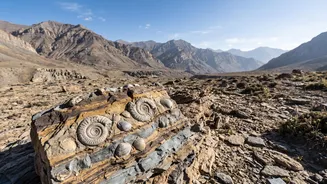
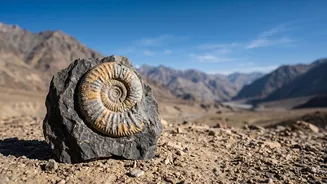
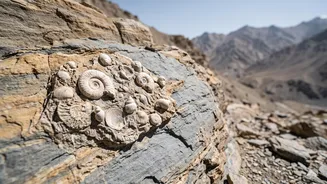
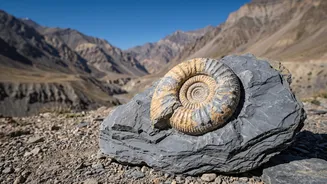
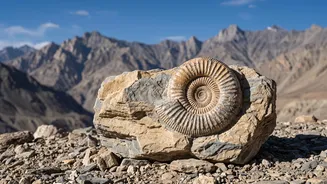
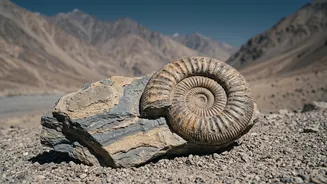
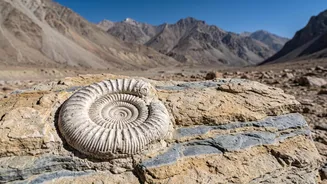
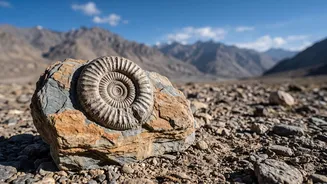
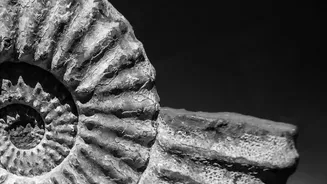
In the arid, cold desert of Nyoma in Ladakh's Changthang region, a geologist has uncovered a remarkable collection of marine fossils. Discovered by Dr. Ritesh Arya, these are not just any fossils; they are the remains of sea creatures like gastropods
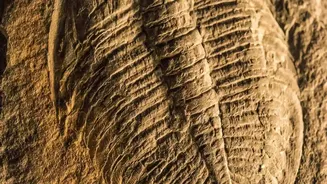
(snail-like molluscs), bivalves, and oyster-like forms that lived approximately 34 to 38 million years ago. Finding remnants of ocean life in a region situated thousands of metres above sea level is a startling discovery that provides a direct window into a vastly different prehistoric world. The fossils are exceptionally well-preserved and are now being documented for detailed study to confirm their precise age and species.
Ladakh's Underwater Past
The existence of marine fossils so far from any ocean is definitive proof that the Himalayas were not always mountains. Millions of years ago, before the Indian subcontinent collided with Asia, a vast body of water called the Tethys Ocean separated the two landmasses. This ancient sea was home to a rich and diverse marine ecosystem. The rocks that now form the highest peaks on Earth, including Mount Everest, were once sediments at the bottom of this ocean. The discovery in Ladakh confirms that this region was once a shallow, near-coastal environment influenced by the warm waters of the Tethys.
The Great Tectonic Collision
So, how did a seabed become the roof of the world? The answer lies in plate tectonics. About 50-60 million years ago, the Indian tectonic plate, which had been steadily moving northward for millions of years, finally crashed into the Eurasian plate. This colossal collision was one of the most significant geological events in Earth's history. The immense pressure caused the land to buckle, fold, and thrust upwards, much like a carpet wrinkling when pushed from one end. The seabed of the Tethys Ocean, with all its accumulated sediments and dead marine organisms, was lifted skyward over millions of years, eventually forming the Himalayan mountain range.
Explaining the 'Subathu Link'
The term 'Subathu Marine Link' refers to the Subathu Formation, a specific sequence of fossil-rich rocks found across the Himalayan foothills, particularly in Himachal Pradesh. These rocks, composed of limestone and green mudstone, were deposited during the final stages of the Tethys Ocean, just as the collision between India and Asia was beginning. They are dated to the Palaeocene to Middle Eocene epochs (roughly 60 to 40 million years ago) and are famous for their abundance of marine fossils. The newly discovered fossils in Ladakh look remarkably similar to those from the Subathu Formation. This suggests that the ancient marine environment of the Subathu Sea extended much farther east into Ladakh than previously thought, providing a crucial 'link' that helps geologists map the true extent of the Tethys before it vanished.
Why This Discovery Is Significant
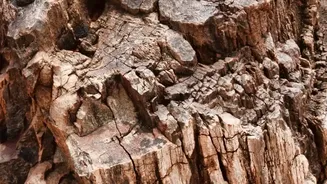
This find is more than just a geological curiosity. It helps scientists refine the timeline of the Himalayan formation and the final closure of the Tethys Ocean. By studying these fossils, researchers can reconstruct the ancient environment, including water temperature and depth, which offers valuable data for understanding long-term climate change. The combination of marine shells with fossil palms and wood found nearby paints a picture of a warm, coastal landscape completely alien to the cold, high-altitude desert seen today. This discovery reinforces how dynamic our planet is and underscores the immense geological forces that have shaped, and continue to shape, the Indian subcontinent. Each fossil is a clue, helping to solve the puzzle of one of the planet's most dramatic geological stories.