



A New Solar Landmark
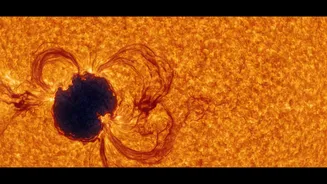
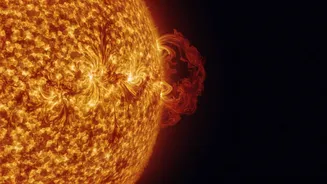
Scientists have released a breathtakingly detailed image of the sun's surface, capturing features as small as a city. Taken by the National Science Foundation's Daniel K. Inouye Solar Telescope in Hawaii, which NASA supports, the image provides the highest-resolution
view of the sun in visible light to date. It reveals a solar landscape filled with swirling, dynamic patterns that look more like a painting than a photograph. Some have even compared the chaotic beauty to Van Gogh's 'Starry Night'. These images are not just for show; they represent a monumental leap in our ability to study the star that makes life on Earth possible.
Peering Through a Powerful Eye
Capturing such an image requires incredible technology. The Daniel K. Inouye Solar Telescope is the world's largest and most powerful solar telescope. Located atop the Haleakalā volcano in Maui, its massive 4-meter primary mirror allows it to collect an immense amount of light, revealing details that were previously impossible to see. For the first time, scientists can observe tiny structures on the sun's surface, or photosphere, and the atmospheric layer just above it, the chromosphere. These images confirm long-held theories about solar physics and open up entirely new questions.
Uncovering Solar Instability
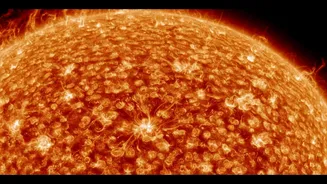
So, what exactly do these new images show? They confirm the existence of a process called the Kelvin-Helmholtz instability (KHI) on the sun. This phenomenon occurs when two fluids or gases moving at different speeds flow past each other, creating waves and swirls. On the sun, this involves streams of super-hot, magnetized gas called plasma. The images reveal whirlpool-like patterns and feathery streaks at the edges of solar granules—the building blocks of the sun's surface. These granules are giant, Texas-sized cells of boiling plasma that transport heat from the sun's interior. Seeing this instability in action is key to understanding how energy moves around the sun.
The Mysteries of Solar Plasma
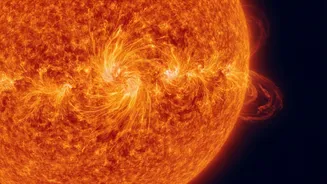
The sun is made of plasma, a state of matter where gas is so hot that its atoms are stripped of their electrons. This plasma is constantly in motion, twisted and guided by powerful magnetic fields. One of the biggest mysteries in solar physics is why the sun's outer atmosphere, the corona, is millions of degrees hotter than its surface. Scientists believe the answer lies in how magnetic energy is transferred and released through the plasma. The newly observed swirls and instabilities are thought to play a crucial role in this process, helping to channel energy upwards and heat the corona.
Why This Matters for Earth
Understanding the sun's behaviour is not just an academic exercise. The same processes that create these intricate patterns can also trigger violent solar events like solar flares and coronal mass ejections (CMEs). These events hurl vast amounts of charged particles and magnetic energy into space. If aimed at Earth, this 'space weather' can disrupt GPS signals, damage satellites, and even threaten our power grids. By studying the sun in such fine detail, scientists hope to improve their ability to predict these major events, moving from a 48-minute warning to a 48-hour one. This gives us more time to protect the technology we rely on every day.