






The Tyranny of Distance
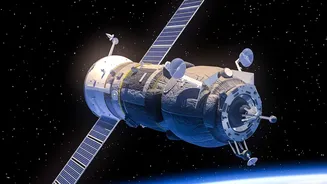
The rockets that took us to the Moon are marvels of chemical engineering, but for destinations like Mars, they are simply too slow. Using current technology, a round trip for astronauts to the Red Planet could take up to three years. Such a long journey
exposes crews to dangerous levels of cosmic radiation and creates immense logistical challenges. To make deep space travel practical and safer for humans, we need a fundamentally new approach to propulsion—one that can drastically cut travel times. NASA's goal is to shorten a Mars mission to about two years, a feat that requires moving beyond traditional chemical rockets.
Enter Nuclear Propulsion
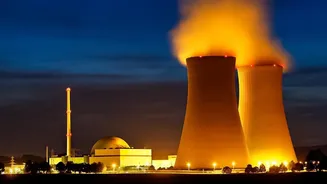
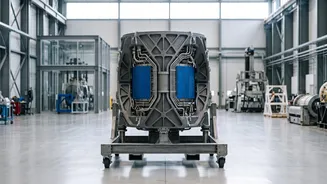
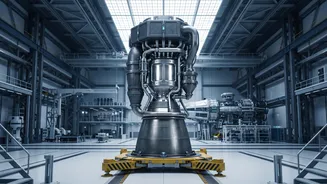
The solution lies in the immense energy density of nuclear fission. Two main types of space nuclear propulsion are being developed. The first is Nuclear Thermal Propulsion (NTP). In an NTP system, a nuclear reactor heats a propellant like liquid hydrogen to extreme temperatures, expelling it through a nozzle to create powerful thrust. NTP offers high thrust and is about twice as efficient as the best chemical rockets, potentially cutting the journey to Mars by 25% or more. The second type is Nuclear Electric Propulsion (NEP). An NEP system uses a reactor to generate electricity, which then powers an ion thruster that expels charged particles to create a gentle but continuous push. While NEP has very low thrust, it is incredibly efficient and can accelerate a spacecraft to enormous speeds over a long period.
A Partnership of Experts
Developing this technology requires a unique blend of expertise, which is why NASA and the U.S. Department of Energy (DOE) have formed a crucial partnership. NASA brings its decades of experience in spaceflight, mission design, and vehicle integration. The DOE, through its national laboratories, contributes its unmatched expertise in nuclear reactor design, safety, and fuel production. This collaboration leverages the strengths of both agencies to tackle the complex challenges of making space nuclear systems a reality. A recent memorandum of understanding signed in October 2026 solidifies this cooperation, aiming to accelerate American leadership in space nuclear technology.
Putting Theory into Practice
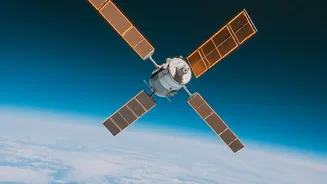
The partnership's most visible project is the Demonstration Rocket for Agile Cislunar Operations (DRACO). A joint effort with the Defense Advanced Research Projects Agency (DARPA), DRACO aims to be the first in-space test of a nuclear thermal rocket engine. The plan involves launching the experimental vehicle into Earth orbit and activating the reactor to gather crucial data on its performance and safety. This demonstration, with major contractors like Lockheed Martin and BWX Technologies, is a critical step to prove the viability of NTP technology and pave the way for its use in future human missions to Mars. The goal is to conduct this groundbreaking test in the late 2020s.
The Grand Engineering Challenge
The road to nuclear propulsion is not easy. Engineers face significant hurdles, including developing materials that can withstand the incredible heat and radiation inside a reactor for years without failing. Ensuring the system is completely safe for the crew and for launch is paramount; the reactor will only be turned on once the spacecraft is in a safe, high orbit. Another challenge is heat management. In the vacuum of space, shedding waste heat from the reactor requires massive radiators. Overcoming these issues, along with navigating regulatory processes and managing public perception, are key parts of the long-term engineering goal.
Powering a Future in Space
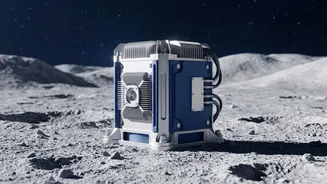
The vision extends beyond just propulsion. The same partnership is also developing projects like Fission Surface Power (FSP), which aims to place a small nuclear reactor on the Moon. Such a system could provide the steady, reliable electricity needed to power a permanent lunar base, operating even during the long, dark lunar nights. A successful demonstration on the Moon would be a stepping stone to deploying similar systems on Mars, enabling long-term human settlement and science. These technologies are seen as essential for establishing a sustained human presence beyond Earth and opening up a new industrial and economic frontier.