


The Planet's Hidden Symphony
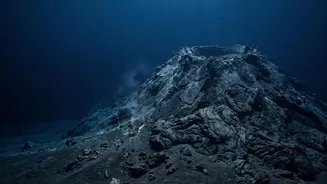
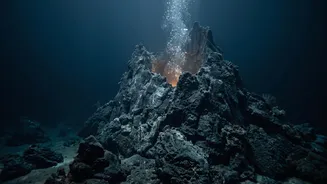
Most of Earth's volcanic activity happens sight unseen, deep beneath the ocean's surface. For decades, monitoring these powerful events was a challenge; many eruptions would occur without us ever knowing. But scientists have a powerful, if unlikely, tool:
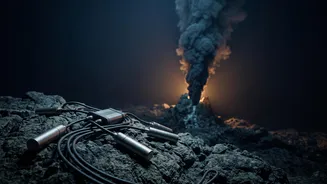
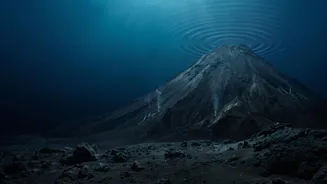
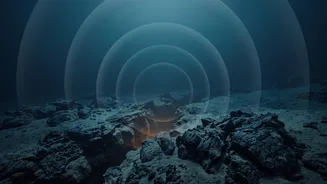
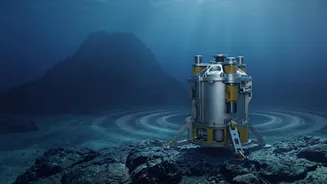
sound. Using networks of underwater microphones called hydrophones, originally developed for military surveillance, researchers can eavesdrop on the rumblings of the planet. Sound travels incredibly efficiently through water, much farther and faster than through air. This means a hydrophone can detect acoustic signals from a submarine volcano thousands of kilometers away. These signals, known as T-waves, are created when seismic energy from an eruption is converted into sound at the seafloor. This global listening network allows us to locate and track underwater events with surprising precision.
Decoding a Volcano's Voice
An underwater eruption doesn’t just make one sound; it produces a complex symphony of noises that tell a story. Sharp, explosive cracks can signal magma hitting cold seawater, while low-frequency rumbles may indicate the movement of magma deep within the Earth's crust. By analyzing the frequency and characteristics of these sounds, scientists can start to piece together what is happening in real-time. Are there small, continuous lava flows, or is pressure building towards a catastrophic explosion? These acoustic fingerprints are crucial. For example, researchers studying Axial Seamount, an active underwater volcano off the coast of the Pacific Northwest, were able to use hydrophone data to identify the exact moment lava reached the seafloor and began erupting. This level of detail is impossible to get from satellite imagery or ship-based observation alone.
The Hunga Tonga Wake-Up Call
In January 2022, the world’s attention turned to the small Pacific island nation of Tonga. The Hunga Tonga-Hunga Ha‘apai volcano erupted with a force that scientists are still working to comprehend. The atmospheric shockwave circled the globe multiple times, and the sound was reportedly heard as far away as Alaska. It was the most powerful volcanic event recorded in the modern era, rivaling the infamous 1883 Krakatoa eruption. While the atmospheric blast was staggering, the eruption also provided a massive, real-world experiment in hydroacoustics. Scientists found that the underwater collapse of the volcano produced a powerful and distinct acoustic signal that traveled through the ocean. Unexpectedly, some hydrophone networks recorded surprisingly weak signals, leading to new investigations into how the immense energy was transferred and how complex seafloor topography might muffle or redirect sound waves. The event was a treasure trove of data, providing critical insights into the physics of a large-scale submarine eruption.
From Sound to Early Warning
The key lesson from Hunga Tonga is that these underwater sounds are more than just a scientific curiosity; they could form the basis of a new type of early warning system. The eruption generated devastating tsunamis through multiple mechanisms that traditional earthquake-based tsunami warnings failed to fully account for. Researchers now believe the unique acoustic signature generated by the volcanic collapse could serve as a direct warning of a dangerous volcanic tsunami in the future. The challenge is to build systems that can rapidly detect and interpret these specific signals, distinguishing them from more common seismic noise, and relaying a warning to coastal communities in time. While still in development, the concept has the potential to save lives in volcanically active regions across the Pacific and beyond, offering a new tool to monitor some of Earth's most unpredictable hazards.