


What is an Evening Elongation?
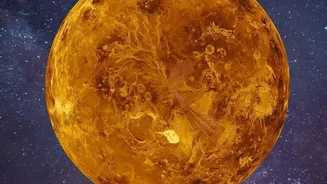
In simple terms, an elongation is the angular separation between the Sun and a planet as seen from Earth. Because Venus orbits the Sun inside of Earth's own orbit, it never strays far from the Sun in our sky. We only ever see it for a few hours after
sunset (as the 'Evening Star') or before sunrise (as the 'Morning Star'). A 'greatest eastern elongation' means Venus has reached its farthest point east of the Sun from our perspective. This is the point where it appears at its highest in the evening sky, making it the best time to view it. After this, it will slowly start to sink back toward the Sun's glare over the following weeks.
A Spectacular Sight in the Twilight
On August 15, Venus will be separated from the Sun by about 46 degrees, which is near its maximum possible separation. It will shine at a brilliant magnitude of -4.4, making it far brighter than any actual star. In fact, aside from the Sun and the Moon, it will be the brightest object in the sky, easily visible even during twilight. If you look closely on the evenings around this date, you might even spot it before the sky is fully dark. On the 15th, a slender crescent Moon will also be nearby, creating a beautiful pairing in the sky.
How and When to Look
Finding Venus is incredibly easy. Simply look low in the western sky shortly after the sun has set. You won't need any special equipment; its steady, powerful glow is unmistakable. For the best view, try to find a location with a clear, unobstructed view of the western horizon, away from tall buildings or trees. While it will be visible for a while after sunset, the planet's relatively low position means it will sink below the horizon a couple of hours later. This event is part of a busy month for skygazers, which also includes the peak of the Perseid meteor shower around August 12-13.
A View Through Binoculars or a Telescope
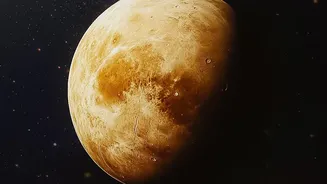
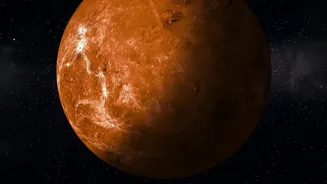
While Venus is a stunning sight to the naked eye, a pair of binoculars or a small telescope can reveal even more. Because we are viewing Venus from the side during its elongation, it will not look like a full circle. Instead, through a telescope, it will appear as a tiny, half-illuminated disc, much like a first-quarter Moon. This is known as dichotomy. Interestingly, due to Venus's thick, light-scattering atmosphere, the moment it appears exactly half-lit (the 'Schröter effect') often occurs a few days earlier than predicted, so it's worth looking in the days leading up to the 15th as well. As August progresses, you can watch through a telescope as the planet's visible disk gets larger but its crescent phase becomes thinner.