



Our Sun, A Temperamental Neighbor
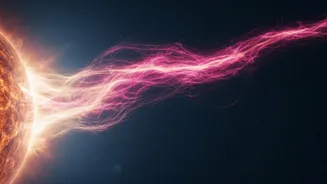
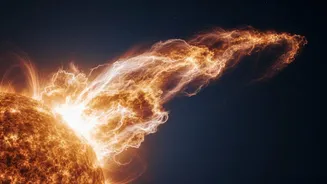
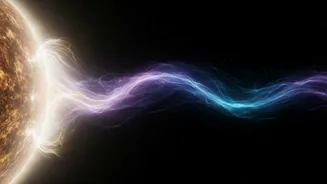
The Sun, the star that makes life on Earth possible, has a volatile side. It constantly streams out a flow of charged particles called the solar wind. Occasionally, it unleashes enormous explosions of plasma and magnetic fields known as coronal mass ejections,
or CMEs. When these billion-ton clouds of solar material are aimed at Earth, they can trigger geomagnetic storms. While they produce beautiful auroras, these storms also pose a significant threat to our modern infrastructure. They can disrupt and damage satellites, interfere with GPS and radio communications, and even overload power grids, potentially causing widespread blackouts.
The Forecasting 'Blind Spot'
For decades, predicting the arrival of a CME has been a major challenge. Scientists could see an eruption leave the Sun and had instruments near Earth to detect its arrival, but the vast 150-million-kilometer journey in between was largely a blind spot. As a CME travels, it interacts with the solar wind, causing its speed and shape to change unpredictably. This meant that even when a potentially hazardous storm was identified, forecasters could only offer a wide arrival window, sometimes as broad as 12 hours, with an error margin of about five hours. This uncertainty makes it difficult for satellite operators and grid managers to take protective measures effectively.
Enter PUNCH: A New Set of Eyes
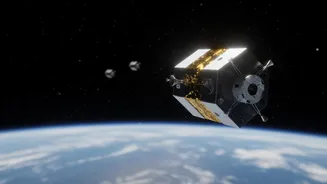
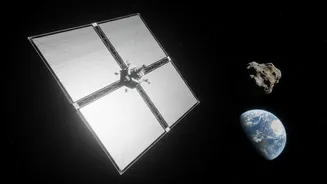
This is the problem NASA's PUNCH mission was designed to solve. PUNCH, which stands for Polarimeter to Unify the Corona and Heliosphere, is not a single spacecraft but a constellation of four suitcase-sized satellites that orbit the Earth. Launched in 2025, these four spacecraft work in concert, using their overlapping fields of view to create a single, continuous 3D picture of the inner solar system. Taking images every four minutes, PUNCH can do something no other instrument could before: watch a CME travel nearly the entire way from the Sun to Earth. This effectively eliminates the blind spot that has hampered space weather prediction for so long.
A Leap Forward in Prediction
The mission recently demonstrated its revolutionary capabilities in a proof-of-concept test. Using images PUNCH captured of a CME from May 2025, scientists ran the data through new computer models. By tracking the storm's leading edge, speed, and evolving shape across the solar system, the model predicted its arrival at Earth. The result was stunning: the forecast was accurate to within 30 minutes, a tenfold improvement over previous methods. After just 12 hours of tracking the eruption, the model confidently predicted it would arrive eight hours later, a level of precision that could transform how we prepare for and mitigate the effects of space weather.
What This Means for Business and Tech
This newfound accuracy is more than just a scientific achievement; it's a critical upgrade for our technology-dependent economy. With more reliable and timely warnings, power grid operators can take preventative actions to avoid catastrophic failures. Satellite companies can safeguard their multi-billion dollar assets by putting them into a safe mode. Airlines, which rely on high-frequency radio over polar routes, can reroute flights to avoid communication blackouts. The data from PUNCH doesn't just improve forecasts; it's also revealing new details about the structure of CMEs, showing them to be clumpier and more complex than previously thought, which will further refine our understanding of space physics.