






The Universe's Invisible Glue
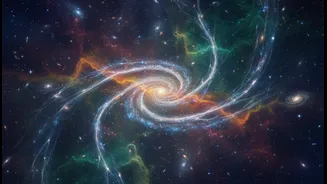
For decades, astronomers have known there's more to the universe than meets the eye. Galaxies spin so fast they should fly apart, and light bends around seemingly empty space. The cause is thought to be dark matter, an invisible substance that doesn't
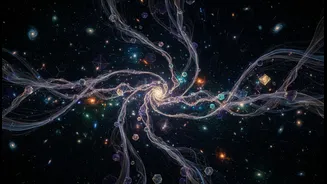
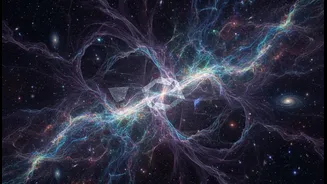
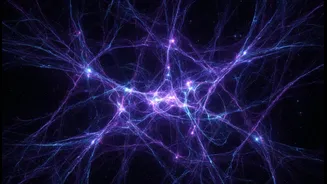
interact with light or ordinary matter but exerts a powerful gravitational pull. This cosmic glue holds galaxies together and forms the vast scaffolding of the universe. The problem? We have never directly detected it, and we still don't know what it's made of. The prevailing theory, known as Cold Dark Matter (CDM), assumes these particles are lone wolves that rarely, if ever, interact with each other except through gravity. But observations are starting to challenge this simple picture.
A Puzzling Contradiction
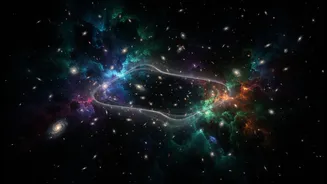
The mystery deepens when we look at how dark matter is distributed. In massive galaxy clusters, observations suggest dark matter particles interact with each other quite a bit, clumping together in dense cores. However, in smaller, dimmer dwarf galaxies, the opposite seems to be true; the dark matter appears much more diffuse and spread out, as if its particles are ignoring each other. This contradiction is a major headache for astrophysicists. How can dark matter be both social and antisocial? The standard Cold Dark Matter model can't easily explain this discrepancy, leading scientists to explore a more complex and interesting possibility: self-interacting dark matter (SIDM).
Enter the Dark Photon
To solve this puzzle, some theorists are turning to a fascinating idea: a new force of nature that only affects dark matter. Just as our familiar electromagnetic force is carried by particles of light called photons, this 'dark force' would be carried by a hypothetical particle called the 'dark photon'. In this scenario, dark matter isn't just one silent particle but part of a hidden 'dark sector' with its own set of rules and interactions. The dark photon would act as a mediator, allowing dark matter particles to communicate and interact with each other in ways we can't see, effectively giving dark matter its own private version of electromagnetism.
How This Solves the Puzzle
The dark photon theory offers an elegant solution to the interaction problem. The strength of this 'dark force' isn't constant; it's velocity-dependent. In the high-speed environment of a massive galaxy cluster, where dark matter particles are zipping past each other, the dark photon mediates a strong interaction, causing them to clump together. But in the slow, quiet suburbs of a dwarf galaxy, the particles move sluggishly. At these low velocities, the force becomes incredibly weak, and the particles barely notice each other, resulting in the diffuse halos that astronomers observe. This velocity-dependent model beautifully explains why dark matter behaves so differently in different cosmic environments, resolving a major tension in our understanding.
The Hunt for Hidden Particles
This is more than just a clever idea on a blackboard. Physicists are actively hunting for evidence of dark photons. Experiments at facilities like CERN are designed to create these particles by smashing high-energy electrons into dense targets. The signature would be a tiny amount of missing energy that can't be explained by standard physics, an energy deficit carried away by an invisible dark photon escaping the detector. While these searches have so far come up empty, each experiment helps to narrow down the possible properties of the dark photon, like its mass and how strongly it might 'mix' with regular photons. This potential mixing offers a tantalizing 'portal' that could finally connect our visible world with the dark sector.