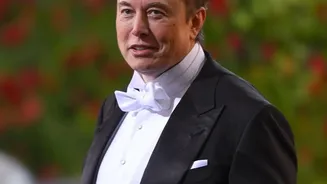






Elon Musk is known for disrupting industries from electric cars to space travel. His latest target? English punctuation. A recent comment about the need for clearer parenthetical markers has grammarians and tech fans talking. But does he have a point?
The Post That Launched a Thousand Debates
In a recent post on his social media platform, X, Elon Musk turned his attention from rockets and AI to the humble em dash. He argued that the rules of English should change to include spaces around em dashes when used for parenthetical phrases, suggesting they currently too closely resemble a hyphenated word. He also opined that the em dash ('—') is 'unpleasantly long' and that the shorter en dash ('–') would be a better length. The critique, a small aside in a larger conversation, quickly sparked discussions about the state of our punctuation and whether the tools we have are really up to the task of clear communication in the digital age.
Our Current Parenthetical Toolbox
Before we invent a new punctuation mark, it's worth reviewing the ones we already have. English uses three main tools to set off parenthetical, or nonessential, information: commas, parentheses, and em dashes. According to most style guides, they exist on a spectrum of interruption. Commas offer the gentlest separation for closely related asides. Parentheses, which appeared around 1500, create a much stronger break, signaling that the information is secondary or a supplementary detail. The em dash sits in the middle, providing a more dramatic pause than a comma but feeling more integrated than a full set of parentheses. It’s often used for emphasis or to set off a phrase that already contains commas.
The Quest for New Punctuation
Musk is far from the first person to wish for more precise punctuation. For centuries, writers and printers have proposed new marks to clarify tone and meaning, especially in text where vocal cues are absent. In the 1580s, English printer Henry Denham proposed a reversed question mark, the 'percontation point', to end rhetorical questions. In 1962, ad executive Martin K. Speckter invented the 'interrobang' (‽), a combination of a question mark and an exclamation point to express excited disbelief. French author Hervé Bazin went even further, proposing a set of six new marks in 1966 to indicate love, conviction, doubt, and, most famously, irony.
The Sarcasm Problem
Perhaps the most sought after new punctuation mark is one for sarcasm. The internet, with its potential for misinterpretation, has only amplified this need. Many have tried to solve it. A trademarked 'SarcMark' was introduced in 2010, resembling a spiral with a dot, but it required users to pay for a font software and was widely criticized. The simple tilde (~) and the nowubiquitous '/s' have become informal, usergenerated solutions, but none have achieved official status. The failure of these marks to gain mainstream adoption highlights a key challenge: a new punctuation mark doesn't just need to be useful; it needs to be easily accessible and widely adopted to have any power.
Do We Really Need a New Mark?
So, back to Musk's original critique. Is there a need for a clearer parenthetical marker? While his specific suggestions about spacing em dashes or preferring en dashes are matters of stylistic preference (many publications, for instance, already put spaces around em dashes), the core question is a valid one. However, the problem may not be the punctuation itself, but rather our collective understanding of it. The existing system of commas, dashes, and parentheses offers a surprisingly nuanced way to convey different levels of separation and emphasis. Perhaps the solution isn't to invent a new tool, but to become better craftspeople with the ones we've had all along. The history of punctuation shows that language evolves through mass usage, not by decree—even if that decree comes from one of the most influential figures of our time.