

A New Eye on the Universe
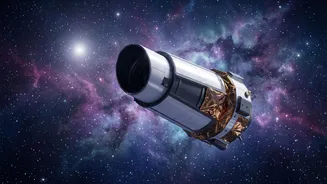
Following a successful launch aboard a SpaceX Falcon Heavy rocket on August 30, 2026, the Nancy Grace Roman Space Telescope is now on its million-mile journey to its final orbit. Named after Dr. Nancy Roman, NASA's first chief of astronomy and the revered
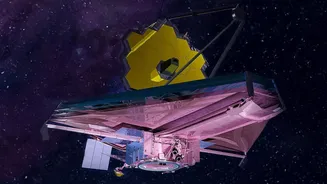
“Mother of Hubble,” this next-generation observatory is not designed to replace its predecessors like Hubble or the James Webb Space Telescope (JWST), but to complement them with a unique and powerful capability. While Hubble and Webb excel at capturing deep, narrow portraits of small patches of the sky, Roman is a wide-angle surveyor. Its primary mission is to create vast cosmic panoramas, mapping the universe with a breadth and speed never before possible. It will settle into an orbit 1.5 million kilometers from Earth, a stable vantage point known as Lagrange Point 2, where it will begin its quest to answer fundamental questions about the cosmos.
The Story Behind the Mirror
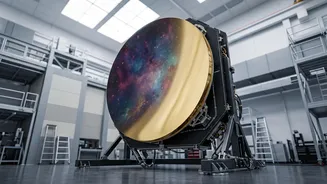
At the heart of the Roman telescope is its primary mirror. Measuring 7.9 feet (2.4 meters) across, it is exactly the same size as the mirror inside the Hubble Space Telescope. This component is what collects the faint light from distant stars and galaxies, making it the most critical piece of hardware for the mission. While the mirror is a marvel of engineering, its origin story is just as remarkable. In an interesting turn of events, the telescope's core optical system was provided to NASA by the U.S. National Reconnaissance Office, which had two such Hubble-sized mirror systems in storage. Repurposing this hardware gave the mission a significant head start. Before its launch, engineers at NASA's Goddard Space Flight Center completed a final, meticulous inspection, confirming the mirror was in perfect condition and ready for its new life exploring deep space instead of looking down at Earth.
Seeing Wider, Not Just Deeper
If the mirror is the heart of the telescope, its Wide Field Instrument (WFI) is its superpower. This is where Roman truly distinguishes itself. While sharing the same mirror size as Hubble, Roman's WFI gives it a field of view that is at least 100 times larger. Imagine looking at the night sky through a straw; that's akin to Hubble's deep but narrow vision. Roman, by contrast, sees a panoramic vista in a single snapshot. This means it can survey enormous swaths of the sky with incredible efficiency. Where it might take Hubble hundreds of individual images and significant time to map a region, Roman can do it in a fraction of the time with comparable image sharpness. This ability to capture massive amounts of data—projected to be about 1.4 terabytes every day—is what will allow it to tackle cosmic mysteries that require huge statistical surveys.
The Hunt for Dark Energy and New Worlds
Roman’s expansive view is tailored for two primary scientific goals. First, it will confront one of the biggest puzzles in physics: dark energy. This mysterious force is believed to be causing the expansion of the universe to accelerate, but scientists know very little about it. By measuring the light from billions of galaxies and observing distant stellar explosions called supernovae, Roman will help astronomers map the structure of the universe and trace its expansion history, providing crucial clues about the nature of dark energy. Second, Roman will conduct the largest census of exoplanets ever undertaken. Using a technique called gravitational microlensing, it is expected to discover thousands of new planets, from gas giants to smaller, rocky worlds, helping us understand how common planetary systems like our own are throughout the galaxy. It will even be able to find so-called 'rogue planets' that wander through space without a host star.
From Launch to First Light
Now that it is in space, the Roman telescope is undergoing a three-month commissioning period. During this time, ground controllers will power on and test its systems, deploy its high-gain antenna, and activate its instruments, including the Wide Field Instrument and the experimental Coronagraph Instrument. The coronagraph is a technology demonstrator designed to block the overwhelming glare of a star, which could one day allow future missions to directly image Earth-like planets. NASA anticipates releasing Roman's first stunning images to the public by early 2027. Once fully operational, the telescope will begin its five-year primary mission, generating an unprecedented atlas of the cosmos that will keep scientists busy for decades to come.