





A Star System Under the Microscope
Located just 63 light-years from Earth, the Beta Pictoris system has long been a favourite subject for astronomers. At only about 23 million years old, it’s a celestial infant, offering a rare, real-time glimpse into how planetary systems form and evolve.
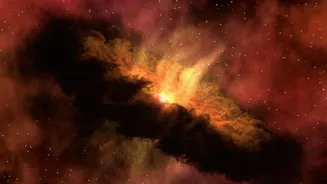
For decades, scientists have studied its massive, bright ring of dust and debris—the leftover building blocks of planets. Within this swirling disk, two massive gas giants, Beta Pictoris b and c, were already known to exist. Beta Pictoris b was one of the very first exoplanets to ever be directly photographed, making the system a cornerstone of exoplanet research. This made it the perfect laboratory for understanding the chaotic dance between young stars, their newly formed planets, and the disks that birthed them.
An Unexpected Signal in the Data
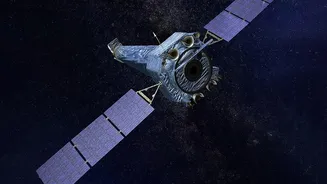
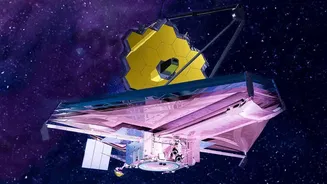
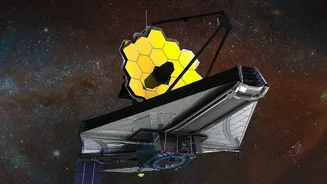
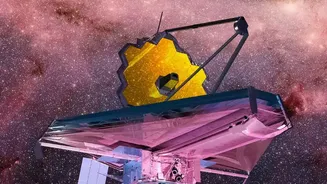
The discovery of the system's third planet, now named Beta Pictoris d, was a complete surprise. The research team, led by Aidan Gibbs of the University of California, San Diego, wasn't looking for a new planet at all. They were using the Webb telescope's powerful Near-Infrared Spectrograph (NIRSpec) to study the atmosphere of the already-known planet, Beta Pictoris b. As they analyzed the data, a telltale signal appeared where they didn't expect it, a chemical fingerprint that didn't match the star, the disk, or the known planets. "We weren't looking for a new planet," Gibbs confirmed in a statement. "We were trying to understand one we already knew existed. Then, this telltale signal appeared."
Peering Through the Dust
Finding Beta Pictoris d wasn't as simple as spotting a point of light. The planet was hidden within the brilliant glare of its star and the thick, foggy debris disk, which makes traditional imaging nearly impossible. Instead of a direct picture, Webb found the planet by detecting the unique chemical signature of its atmosphere. The NIRSpec instrument breaks light down into its component wavelengths, creating a spectrum. Within this spectrum, the team identified the telltale absorption lines of methane, carbon monoxide, and water vapor—clear evidence of a planetary atmosphere. This spectroscopic method allowed them to effectively see through the dust and confirm the presence of a world that had remained invisible for years.
Meet the New Family Member
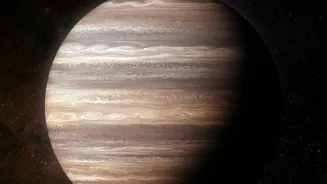
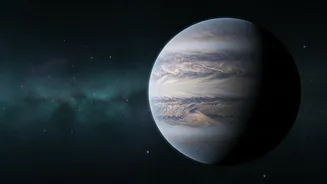
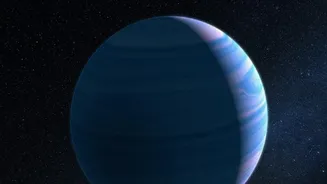
So what do we know about this newfound world? Beta Pictoris d is a gas giant, estimated to be at least twice the mass of Jupiter, making it the smallest of the three planets found in the system. It has the widest orbit of the trio, circling its star at a distance comparable to Neptune's orbit in our own solar system. This position is particularly fascinating because it places the planet just inside the inner edge of the famous debris disk. For years, astronomers had predicted that an unseen planet could be responsible for gravitationally sculpting the disk's sharp edge and other strange structures. The discovery of Beta Pictoris d in this exact region seems to confirm those theories, making it the long-suspected architect of its system's design.
A New Way to Find Planets
Beyond completing the family portrait of the Beta Pictoris system, this discovery opens up a powerful new avenue for finding exoplanets. It is the first time a planet has been found primarily through moderate-resolution spectroscopy, proving that astronomers can hunt for worlds based on their atmospheric fingerprints alone. This is a game-changer for finding planets in complex, high-glare environments like young star systems or the centers of galaxies, where direct imaging often fails. With this new technique in their toolkit, astronomers are hopeful that the James Webb Space Telescope will continue to uncover hidden worlds that have, until now, been playing a cosmic game of hide-and-seek.