


The Challenge of Finding Your Way
For decades, navigating in space has relied on a constant conversation with Earth. Huge antennas in the Deep Space Network track spacecraft, calculating their position and trajectory. This works well for missions in deep space, but it's not ideal for real-time,
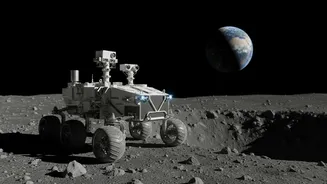
on-the-ground navigation. For the Artemis program, which aims to establish a sustained human presence on the Moon, astronauts and rovers need to know precisely where they are without waiting for instructions from Mission Control. They need to traverse complex terrain, rendezvous with landers, and pinpoint scientifically interesting sites with an accuracy previous missions never required. Relying solely on Earth is slow and creates a bottleneck, especially in areas like the lunar south pole where the line of sight to Earth can be frequently obstructed.
Introducing LunaNet: An Internet for the Moon
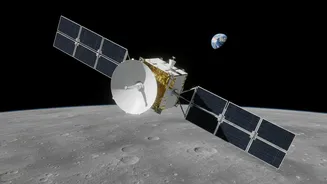
NASA's answer is an ambitious architecture called LunaNet. Think of it less as a single technology and more as an internet-of-things for the Moon, providing communication and navigation services to any user, whether they are in orbit or on the surface. The project responsible for bringing this to life is the Lunar Communications Relay and Navigation System, or LCRNS. This system will create an infrastructure of satellites and surface assets that work together. A key recent development involves a payload called the NavCube3-mini. On July 13, NASA delivered this compact, 3.5-pound receiver to the commercial company Intuitive Machines. This small box is a major piece of the puzzle, designed to give a lunar satellite its own sense of direction.
How a Lunar 'GPS' Will Work
The NavCube3-mini is designed to do something remarkable: pick up the faint signals from Earth's existing Global Navigation Satellite Systems (GNSS), like the U.S. GPS and Europe's Galileo, from all the way at the Moon. These signals are not intended to reach that far, but with a highly sensitive receiver, they can be used. The NavCube3-mini will fly aboard the Altus-1 satellite, the first of a planned five-satellite relay constellation by Intuitive Machines, with a launch targeted for late 2026. This satellite will use the NavCube3-mini to determine its own position autonomously, without needing constant tracking from Earth. Once this network of relay satellites is operational, it will provide positioning, navigation, and timing (PNT) services directly to users on the Moon, creating a true lunar GPS. This removes the reliance on Earth and provides the instant, precise location data needed for complex operations.
Powering the Artemis Generation
This technology is a fundamental enabler for the entire Artemis program. With reliable navigation, astronauts can explore farther from their landing sites with greater confidence and safety. It will allow rovers to be operated remotely with high precision, enabling construction of habitats and mining for resources like water ice, which could be used for drinking water or rocket fuel. Furthermore, a stable navigation network is critical for landing accuracy. The Artemis missions are targeting rugged, unexplored areas of the Moon, and the ability for a lander to navigate to a precise, safe spot is paramount. Technologies like the Navigation Doppler Lidar (NDL), which successfully demonstrated its capabilities in early 2024, will work in concert with this broader network to ensure safe touchdowns.
Building a Self-Sufficient Lunar Economy
Ultimately, LunaNet and the LCRNS project are about more than just supporting NASA missions. By partnering with commercial companies like Intuitive Machines, NASA is acting as an anchor customer, helping to bootstrap a commercial market for lunar services. This interoperable network is designed so that international partners and other private companies can add their own satellites and systems to it. Just as GPS enabled countless industries on Earth, a reliable communications and navigation network on the Moon is the foundational utility needed for a future lunar economy. It paves the way for commercial transport, resource extraction, and scientific research to operate efficiently and safely, far from home.