







The Cycle of Creation and Dissolution
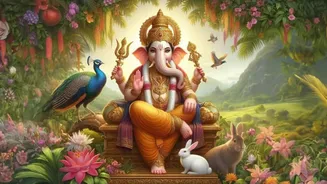
At its heart, Visarjan represents the fundamental Hindu belief in the cycle of life, death, and rebirth. This cosmic rhythm consists of creation (srishti) and dissolution (pralaya). The festival begins with 'prana pratishtha', a ritual that invites the divine
presence into a physical form—the clay idol. For days, this idol is worshipped as a living embodiment of Ganesha. The Visarjan marks the end of this phase. Just as the idol is sculpted from the earth, its immersion into water signifies a return to the elements. This act mirrors the idea that all forms in the universe, including our own bodies, are temporary and will eventually merge back into nature. It's a powerful reminder that while forms are transient, the divine energy itself is eternal and formless.
A Lesson in Letting Go
Over the course of the festival, devotees develop a deep emotional connection to the idol in their homes and communities. The Visarjan ceremony, therefore, becomes a practical lesson in detachment, or 'vairagya'. The act of lovingly letting go of the cherished idol teaches that true devotion is not about clinging to a physical form but about internalising the divine spirit. It reinforces the philosophical understanding that the material world is impermanent. By willingly participating in this farewell, devotees practice releasing attachments to the tangible, acknowledging that the essence of Ganesha—wisdom, prosperity, and the power to remove obstacles—remains with them long after the idol has dissolved. The chants of “Pudhchya Varshi Lavkar Ya” (Come back soon next year) transform the sadness of departure into a hopeful anticipation of renewal.
The Sacred Power of Water
In Hindu philosophy, water is not merely a physical element; it is a sacred medium of purification and life. Rivers, in particular, are considered holy, possessing the power to cleanse spiritually and physically. Immersing the Ganesha idol in a body of water is symbolic of a spiritual cleansing. It is believed that as Lord Ganesha returns to his celestial abode, he takes with him the troubles and obstacles of his devotees, which are then dissolved in the purifying waters. The water acts as a transitional element, representing the cosmic ocean from which all creation emerges and into which it eventually merges. The ritual therefore connects the individual act of worship with a universal, cosmic principle.
The Journey Home
Beyond the philosophical layers, there is also a simpler, narrative symbolism. Visarjan is seen as the culmination of Lord Ganesha's visit to the homes of his devotees on Earth. After a stay of up to ten days, during which he is treated as an honoured guest, the immersion procession is his ceremonial journey back to his parents, Lord Shiva and Goddess Parvati, in their divine abode of Kailash. The music, dancing, and grand scale of the processions are a celebratory send-off, filled with gratitude for his blessings and for removing the obstacles from the lives of his followers. It’s a farewell party fit for a beloved deity who has graced the mortal realm with his presence.
Modern Meaning and Eco-Consciousness
In recent years, the symbolism of Visarjan has evolved to include ecological awareness. The core idea of the idol returning to nature has prompted important conversations about how the ritual is performed. Traditionally, idols were made of natural clay ('shadu mati'), which dissolves harmlessly in water. However, the widespread use of Plaster of Paris (PoP) and toxic paints has led to significant water pollution, harming marine life and contradicting the festival's inherent respect for nature. This has inspired a powerful movement towards eco-friendly celebrations. Devotees are increasingly choosing unpainted clay idols or those coloured with natural pigments. Many now opt for symbolic immersion at home in a bucket or tub, later using the dissolved clay and water for their plants, beautifully completing the cycle of 'earth-to-earth'. This modern adaptation doesn't dilute the ritual's meaning; it deepens it, aligning the ancient philosophy of oneness with nature with the urgent, contemporary need to protect it.