




A Foundation Weakened by a Warming World
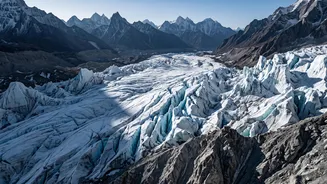
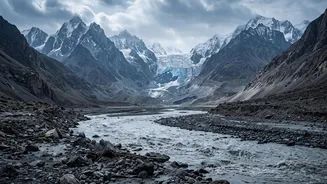
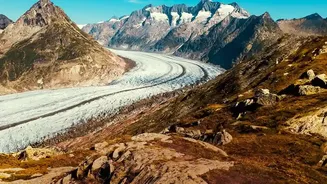
The story of a glacial flood begins long before the deluge. Across the Himalayas, rising global temperatures are causing profound changes. Glaciers, once stable rivers of ice, are melting at an accelerated rate. This warming does more than just shrink
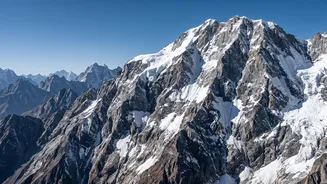
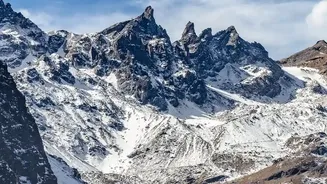
the ice; it fundamentally destabilises the mountain environment. Permafrost, the frozen 'glue' holding rock and soil together on steep slopes for millennia, begins to thaw and weaken. As glaciers retreat, they leave behind unsupported cliff faces and can also feed growing lakes of meltwater, often held back by nothing more than unstable walls of rock and debris known as moraines. This creates a precarious situation, where entire mountain faces and the glaciers attached to them become more prone to failure.
The Trigger: A Catastrophic Failure
All it takes is a trigger. This can be a heavy rainfall event, an earthquake, or simply the point where the weakened rock and ice can no longer support their own weight. In many recent events, including the devastating 2021 Chamoli disaster, the trigger was a colossal rock and ice avalanche. A massive chunk of a mountain, sometimes weighing millions of tonnes and mixed with glacial ice, breaks free from a high-altitude peak. As it detaches, it begins a near-vertical fall, sometimes for several kilometres. The energy involved is almost unimaginable, with the impact registering on seismic sensors like a moderate earthquake. This initial collapse is not yet a flood, but it is the violent first step that sets the devastating, and rapid, chain of events in motion.
The Physics of a Flash Flood
This is where the speed comes from. The immense energy of the fall is the engine of the flood. As the mass of rock and ice plummets and then crashes into the valley floor, the force and friction generate a tremendous amount of heat. This intense heat can instantaneously melt the ice within the avalanche mixture. Scientific analysis of the Chamoli event concluded that the energy of the fall was sufficient to convert the avalanche's entire ice content—about 20% of the total mass—into water. This process creates a highly mobile, water-rich slurry from what was, moments before, solid rock and ice. The process is so efficient that it bypasses the need for a pre-existing large glacial lake to be the main source of the water, explaining why these floods can appear to burst from nowhere.
From Slurry to Destructive Debris Flow
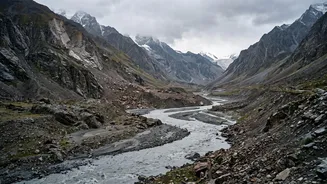
The result is not a clean flood of water, but a fast-moving debris flow. This turbulent mixture of water, mud, pulverised rock, and ice boulders has immense destructive power. As it hurtles down the narrow mountain valleys, it doesn't just flow over the landscape; it scours it. The slurry picks up more material as it goes—sediment, boulders, and trees—growing in volume and destructive capacity. This is a key reason for the speed and devastation. The flow can move at speeds of 60 km/h or more, behaving less like water and more like liquid concrete, destroying bridges, hydropower dams, and entire buildings in seconds. In some cases, the debris can temporarily block the river, causing water to build up before bursting through with even greater force.