

The Solar System's Odd One Out
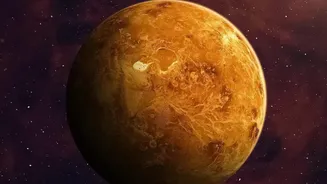
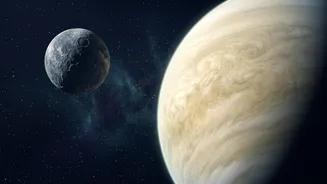
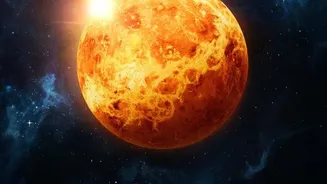
In our cosmic neighbourhood, moons are the norm, not the exception. Earth has its familiar satellite, Mars has two small ones, and the gas giants host entire collections of them. Yet Venus, a planet so similar to our own in structure, stands alone and moonless.
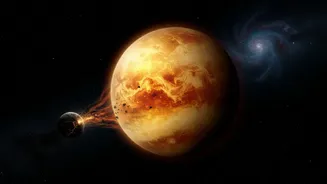
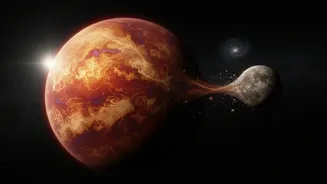
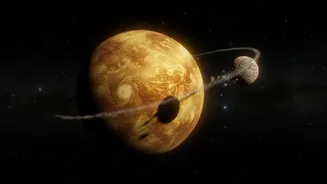
For decades, scientists have floated two main ideas to explain this. One theory proposed that Venus simply never experienced the kind of massive, debris-creating impact that is thought to have formed Earth's Moon. Another suggested that if a moon did form, it was destroyed by a second, catastrophic collision long ago. But recent simulations point to a third, more intimate and unsettling possibility: Venus may be moonless because it devoured its own child.
A Dance of Gravity and Spin
The new explanation, detailed in a study published in The Astrophysical Journal, comes from astrophysicist Stephen Kane and his colleagues at the University of California, Riverside. Their computer models suggest that no external catastrophe was needed. Instead, the planet's own physics could have doomed its hypothetical moon. The key lies in tidal forces and rotational speed. Earth rotates relatively quickly, completing a spin every 24 hours. This fast rotation transfers energy to our Moon, causing it to slowly drift away from us at a rate of about four centimetres per year. Venus, however, is the solar system's slowest spinner, taking 243 Earth days to complete just one rotation. This sluggish spin has the opposite effect, creating a gravitational relationship that would pull a moon inward rather than push it away.
Simulating a Cosmic Collision
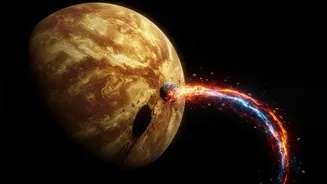
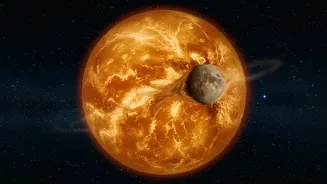
To test this idea, Kane's team ran a series of sophisticated simulations. First, they modeled the Earth-Moon system to ensure their calculations were accurate, successfully replicating its known evolution. Then, they turned to Venus. They created models of the planet with hypothetical moons of various sizes, from half to ten times the mass of Earth's Moon, and tested different initial rotation speeds for the planet. In a surprisingly consistent result across most scenarios, the outcome was the same: the moon's orbit would decay, and it would spiral inward until it crashed into Venus. The simulations showed that larger moons would meet this fiery end even faster. According to the models, this cosmic merger would have likely occurred within the first billion years of Venus’s history.
What This Changes About Venus
This theory doesn't just solve the riddle of the missing moon; it could also help explain some of Venus's other strange characteristics. The immense energy and momentum transferred from such a colossal impact could have had profound effects, potentially altering the planet's geology, climate, and even its rotation. Some scientists suggest the event might have contributed to the runaway greenhouse effect that turned Venus into the scorching hot world it is today, with surface temperatures high enough to melt lead. Proving this theory is difficult, as a massive resurfacing event about a billion years ago appears to have erased most of Venus's older geological history. Any definitive evidence of a devoured moon may now be hidden deep within the planet's interior.
A New Lens on Distant Worlds
While this research provides a plausible history, it is important to note that it doesn't prove Venus ever had a moon—only that if it did, the planet likely couldn't keep it. This insight has implications beyond our own solar system. It suggests that for exoplanets orbiting other stars, especially those with slow rotations, the ability to form a moon doesn't guarantee its long-term survival. As we search for habitable planets, this becomes a key factor, since a large moon can play a crucial role in stabilizing a planet's axis and climate. Upcoming NASA missions to Venus, like DAVINCI+ and VERITAS, are expected to launch around the end of the decade and will provide a much closer look at the planet's geology and past, potentially offering new clues to solve this enduring mystery.